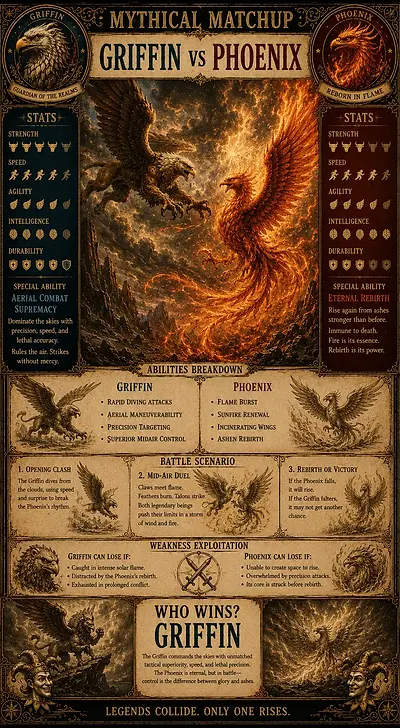
Ultimate Mythical Matchup
Comparative Threat Assessment: the Archives of the Mythological Research Society
Some creatures dominate through strength. Others through terror. But a rare few become legends because they represent something larger than death itself.
The Phoenix is the immortal flame made flesh — a celestial creature associated with rebirth, purification, and catastrophic fire.
The Griffin is the ancient guardian king of the skies, revered across civilizations as a symbol of divine vigilance, nobility, and lethal aerial supremacy.
One cannot truly die. The other was seemingly designed to kill anything that flies.
If these mythological titans clashed, which creature would prevail? This archival combat report examines the most likely outcome.
What Is the Phoenix?
The Phoenix appears across numerous mythological traditions including:
-
Persian mythology
-
Chinese mythological parallels
Most records describe the Phoenix as:
-
an immortal avian entity,
-
wreathed in supernatural flame,
-
capable of self-resurrection after death.
The creature’s defining trait is cyclical rebirth. Upon destruction, the Phoenix:
-
combusts,
-
collapses into ash,
-
and eventually reforms entirely anew.
Field observations also suggest:
-
immunity to ordinary fire,
-
extreme heat generation,
-
radiant light emission,
-
and psychological effects associated with awe or reverence.
The Phoenix does not fear death. That complicates combat considerably.


What Is the Griffin?
The Griffin — possessing the body of a lion and the head and wings of an eagle — originated within ancient Middle Eastern and Mediterranean mythology before spreading across Europe.
Historically, Griffins served as:
-
guardians of treasure,
-
protectors of sacred locations,
-
royal war beasts,
-
and symbols of divine authority.
Archival classifications describe the Griffin as:
-
highly territorial,
-
aerially dominant,
-
exceptionally intelligent,
-
and violently protective.
Unlike many mythological predators, the Griffin combines:
-
feline hunting instincts,
-
avian aerial precision,
-
and coordinated tactical aggression.
It is not merely powerful. It is engineered for pursuit.
Physical Comparison
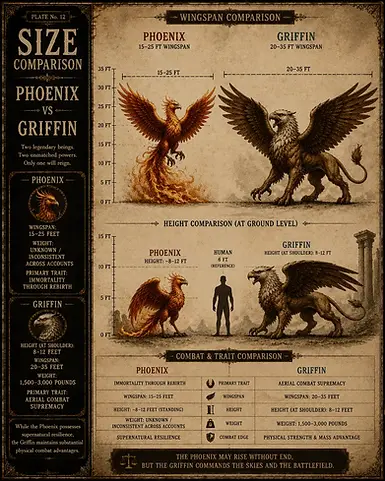
Size
Phoenix
-
Wingspan: Estimated 15–25 feet
-
Weight: Unknown / inconsistent across accounts
-
Primary Trait: Immortality through rebirth
Griffin
-
Height: 8–12 feet at shoulder
-
Wingspan: 20–35 feet
-
Weight: 1,500–3,000 pounds
-
Primary Trait: Aerial combat supremacy
While the Phoenix possesses supernatural resilience, the Griffin maintains substantial physical combat advantages.
Durability & Regeneration
Advantage: Phoenix
This fundamentally alters the matchup. The Phoenix may be temporarily destroyed, but permanent death appears impossible under ordinary conditions.
Even catastrophic injury can trigger:
-
combustion,
-
rebirth,
-
and full biological restoration.
The Griffin can win physical engagements repeatedly. The problem is that the Phoenix keeps returning. Which, from the Griffin’s perspective, must become deeply exhausting.

Strength
Advantage: Griffin
The Griffin possesses:
-
crushing talon strength,
-
predatory bite force,
-
aerial momentum attacks,
-
and combat-adapted musculature.
The Phoenix relies less on brute force and more on:
-
heat,
-
endurance,
-
and supernatural persistence.
In direct physical combat, the Griffin holds a decisive edge.
Speed & Agility
Advantage: Griffin
The Griffin is one of mythology’s premier aerial hunters.
Key advantages include:
-
rapid diving attacks,
-
aerial maneuverability,
-
precision targeting,
-
and superior midair combat control.
The Phoenix is fast, but its flight patterns appear:
-
more graceful than tactical,
-
less optimized for predatory combat,
-
and occasionally ritualistic in nature.
The Griffin fights like a weapon.
The Phoenix flies like a living solar event.
Those are not the same thing.
Intelligence & Tactical Ability
Slight Advantage: Griffin
The Griffin demonstrates:
-
territorial strategy,
-
coordinated hunting behavior,
-
and environmental awareness.
The Phoenix appears intelligent but less overtly combative. Most records portray the Phoenix as:
-
reactive rather than aggressive,
-
symbolic rather than territorial,
-
and strangely indifferent to domination.
The Griffin seeks victory. The Phoenix appears unconcerned with losing individual battles.
That creates a difficult psychological dynamic.
Battle Environment Analysis
Scenario 1: Open Sky Combat
Advantage: Griffin
In aerial battle, the Griffin’s:
-
maneuverability,
-
diving speed,
-
and close-range combat ability
allow it to dominate direct engagements.
The Phoenix risks repeated physical overwhelm.
Estimated Griffin victory probability (single engagement): 67%
Scenario 2: Extended Attrition Warfare
Advantage: Phoenix
If the conflict becomes prolonged, the Phoenix gains overwhelming strategic advantage.
The Griffin:
-
tires,
-
bleeds,
-
ages,
-
and eventually weakens.
The Phoenix does not appear constrained by those limitations.
Estimated Phoenix victory probability (long-term conflict): 72%
Weaknesses
Phoenix Weaknesses
-
Limited offensive physicality
-
Potential vulnerability during rebirth phase
-
Less specialized for direct combat
-
Fire resistance varies among mythological accounts
Griffin Weaknesses
-
Mortal biology
-
Territorial aggression can create predictability
-
Vulnerable to prolonged heat exposure
-
Sustained combat fatigue
Psychological Warfare
Both creatures generate catastrophic fear responses in humans, but for entirely different reasons.
Griffin Terror
The Griffin inspires fear through dominance. Witness accounts describe:
-
thunderous wingbeats,
-
predatory dives,
-
and overwhelming territorial aggression.
The Griffin feels like a hunter.
Phoenix Terror
The Phoenix inspires something stranger. Witnesses frequently describe:
-
awe,
-
disorientation,
-
religious panic,
-
and existential dread.
Killing something that calmly returns from death tends to damage morale significantly.
Final Verdict
Likely Victor: Phoenix (Long-Term Edge)
The Griffin dominates most physical encounters and likely wins the majority of direct aerial engagements. However, the Phoenix’s apparent immortality fundamentally shifts the outcome of sustained conflict.
The Society’s official assessment concludes:
“The Griffin wins the battle. The Phoenix survives the war.”
Estimated Battle Duration
Several minutes to potentially indefinite cycles of conflict.