

What is The Hydra?
(Myth, Powers, Weaknesses & Origins)
The Hydra is one of the most dangerous creatures in Greek mythology—a massive serpentine beast infamous for a single, deeply inconvenient trait: cutting off one of its heads only creates more of them.
Most records describe the Hydra as a multi-headed reptilian predator dwelling in swamps and marshlands near the ancient region of Lerna. It is commonly associated with poison, regeneration, and prolonged death for anyone attempting direct combat.
Unlike many mythical creatures that rely on speed or brute force alone, the Hydra thrives through escalation. The longer a fight lasts, the worse the situation becomes. Which explains why most historical survival accounts are notably short.

Origin & Mythology
The Hydra originates from Greek mythology and is most famously tied to the region of Lerna. According to Hydra mythology, the creature was the offspring of two primordial monsters:
Appearance & Anatomy
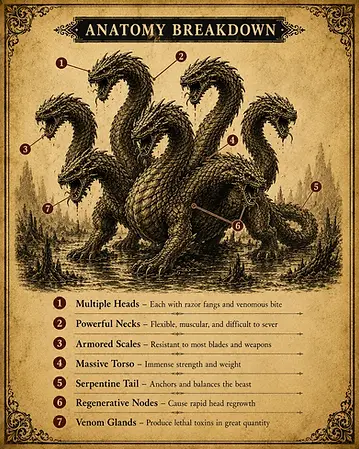
Descriptions of the Hydra vary, though several characteristics remain consistent across mythological accounts.
Massive serpent-like body
Multiple elongated necks ending in reptilian heads
Dark scales resistant to conventional weapons
Venomous blood and breath
Central immortal head (in some versions of the myth)
Eyes often described as glowing or sulfuric in appearance
The exact number of heads differs between records. Some accounts claim nine, while others describe dozens—or numbers too large to count accurately during active combat.
Which is understandable.
Field Profile
A quick-read threat assessment from the Legends of Myth creature archive.
Threat Class
Class V: Legendary Calamity
Best Known For
regenerating heads, venom, and multiplying threats
Danger Level
10/10
Strength
9/10
Intelligence
3/10
Magic Power
8/10
Speed / Mobility
5/10
Stealth / Ambush
4/10
Weakness Exploitability
3/10
Survival Difficulty
10/10
Creature Stats
Abilities & Powers
Head regeneration — severed heads rapidly regrow, often multiplying
Venomous blood — highly toxic and lethal on contact
Poisonous breath — capable of contaminating surrounding air
Extreme durability — resistant to standard weapons and physical damage
Area denial — difficult to approach safely due to multiple attack vectors
Combat escalation — grows increasingly dangerous during prolonged fights
Weaknesses
Fire vulnerability — cauterization prevents head regeneration
Slow movement on open terrain — more effective in confined or marshy environments
Centralized body structure — necks are dangerous, but core body remains critical
Overextension risk — multiple heads can create coordination limitations
Predictable aggression — often attacks relentlessly rather than strategically
Habitat
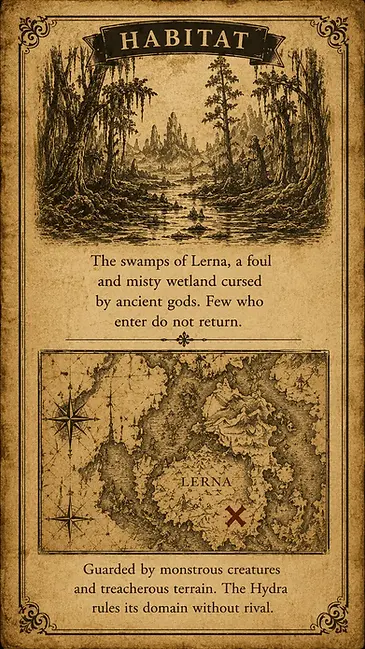
The Hydra is most commonly associated with swamps, marshlands, and stagnant waterways.
Its preferred environment provides several advantages:
Concealment within fog and reeds
Restricted movement for prey
Natural amplification of venom contamination
Moisture-rich terrain beneficial for regeneration
Hydras are highly territorial creatures and appear to remain near fixed lairs for extended periods. Nearby ecosystems are typically marked by:
dead vegetation
poisoned water sources
unexplained disappearances
and a general absence of anything displaying sound survival instincts
How to Defeat It
First: do not panic when the number of heads increases.
This sounds obvious in theory. Historically, it has proven less achievable in practice.
To defeat a Hydra:
Avoid attacking blindly
Use fire immediately after severing a head
Prevent the creature from retreating into water or marsh cover
Target the central body rather than becoming distracted by regeneration cycles
Most importantly: bring assistance.
Even Heracles required support to cauterize the wounds effectively. Attempting to fight a Hydra alone dramatically increases the likelihood that local historians will later describe you as “tragically ambitious.”
Could You Survive?
Your survival odds depend heavily on distance.
From very far away: reasonable
From medium distance: declining rapidly
From “I think I can take it” distance: effectively nonexistent
The Hydra combines:
poison
regeneration
overwhelming attack angles
and the unique ability to punish aggression itself
Which makes it one of the least forgiving creatures in mythology.
Estimated survival odds: extremely low


Hydra FAQ
What is the Hydra in Greek mythology?
The Hydra is a giant multi-headed serpent from Greek mythology that lived in the swamps of Lerna. It is best known for its ability to regenerate lost heads, making it one of the most dangerous monsters ever faced by Heracles during his Twelve Labors.
How many heads did the Hydra have?
Ancient sources disagree on the exact number. Some accounts describe the Hydra as having nine heads, while others claim it possessed dozens or even hundreds. The most consistent detail is that one of its heads was immortal.
What happened when the Hydra lost a head?
When one of the Hydra's heads was severed, two new heads would grow back in its place. This regenerative ability made the creature nearly impossible to defeat through brute force alone.
Who killed the Hydra?
The Hydra was defeated by Heracles (Hercules in Roman mythology) during his second labor. With the help of his nephew Iolaus, Heracles cauterized each neck stump with fire after severing a head, preventing new heads from growing.
Why was the Hydra so difficult to defeat?
The Hydra combined immense size, multiple attacking heads, deadly venom, and regenerative powers. Every successful attack initially made the creature stronger because new heads would replace the ones that were cut off.
Where did the Hydra live?
The Hydra lived in the marshes and wetlands of Lerna, a region in ancient Greece associated with springs, caves, and entrances to the Underworld. Its swampy habitat made it even more dangerous to approach.
What powers did the Hydra have?
The Hydra possessed several supernatural abilities, including:
Rapid head regeneration
Deadly venom
Extraordinary strength
Near immortality
Resistance to conventional weapons
Some myths also describe its breath and blood as highly toxic.
Was the Hydra immortal?
Most versions of the myth describe one of the Hydra's heads as immortal. While the creature itself could be defeated, this final head could not simply be cut off and killed like the others.
What did Heracles do with the Hydra's blood?
After defeating the Hydra, Heracles dipped his arrows in its venomous blood. These poisoned arrows later became some of the deadliest weapons in Greek mythology.
What does the Hydra symbolize?
The Hydra often symbolizes problems that multiply when confronted incorrectly. The phrase "cut off one head and two more grow back" is commonly used to describe challenges that become larger when treated with simple solutions.
Is the Hydra a dragon?
Not traditionally. The Hydra is usually classified as a serpentine monster rather than a true dragon. However, modern fantasy often portrays the Hydra with dragon-like features because of its multiple reptilian heads and immense size.
Is the Hydra related to other Greek monsters?
Yes. According to Greek mythology, the Hydra was one of the offspring of the monsters Typhon and Echidna. Its siblings include Cerberus, Chimera, the Nemean Lion, and several other legendary beasts.
Could the Hydra be killed without fire?
According to the myth, no. Severing heads alone only caused more to grow. Fire was required to cauterize the wounds and stop the regeneration process, making it the key to the Hydra's defeat.
Why is the Hydra one of the most famous Greek monsters?
The Hydra's unique regenerative ability, connection to Heracles, and lasting influence on fantasy stories have made it one of the most recognizable creatures in mythology. It remains a symbol of resilience, danger, and seemingly impossible challenges.