
What is the Bigfoot?
(Myth, Powers, Weaknesses & Origins)
Bigfoot is one of the most famous cryptids in modern folklore—a massive ape-like humanoid reportedly seen in remote forests across North America. Despite decades of investigations, blurry photographs, footprint casts, eyewitness accounts, and an alarming number of low-quality documentaries, definitive proof remains elusive.
Unlike dragons or hydras, Bigfoot occupies a strange middle ground between mythology and possibility. It is not ancient enough to feel symbolic, yet widespread enough to resist dismissal entirely.
This uncertainty is part of what keeps the legend alive.
If Bigfoot were merely a story, interest likely would have faded long ago. Instead, sightings continue. Footprints appear. Campsites are disturbed. And every few years, someone confidently announces they finally captured clear evidence—only for the footage to resemble a large carpet moving aggressively through fog.
Historically, this has not helped.
Origin & Mythology
Bigfoot originates primarily from North American folklore and cryptid tradition, though stories of large wild humanoids appear across many Indigenous cultures long before modern media popularized the creature.
The creature is most strongly associated with:
Pacific Northwest
Canada
Rocky Mountains
Many Indigenous traditions describe beings resembling Bigfoot as:
forest guardians
hidden wilderness people
or supernatural entities connected to remote lands
The modern term “Bigfoot” became widely known after enormous footprints were discovered in California during the 1950s.
The creature is also frequently called:
Sasquatch
Grassman
Skunk Ape (regional variation)
Which suggests either remarkable geographic range or a species with unusually strong branding consistency.
Appearance & Anatomy
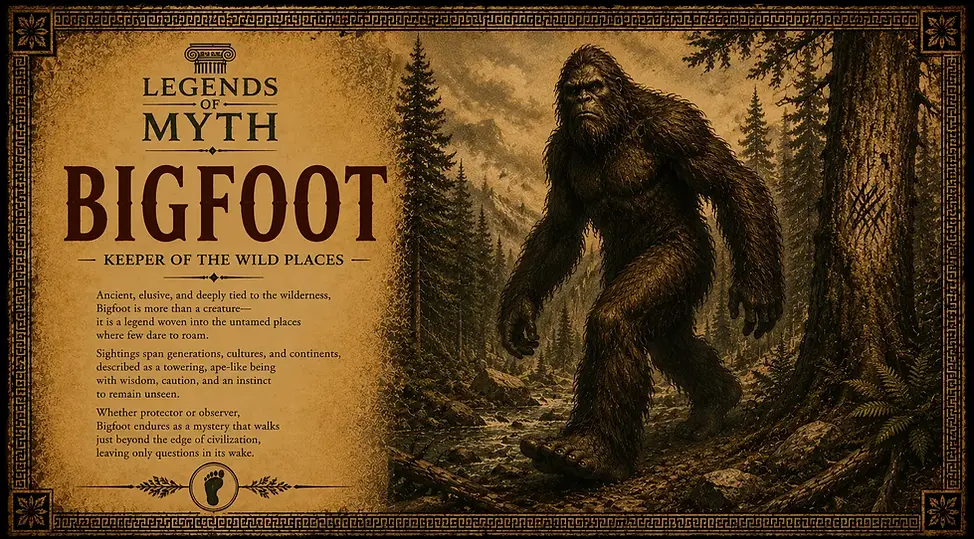
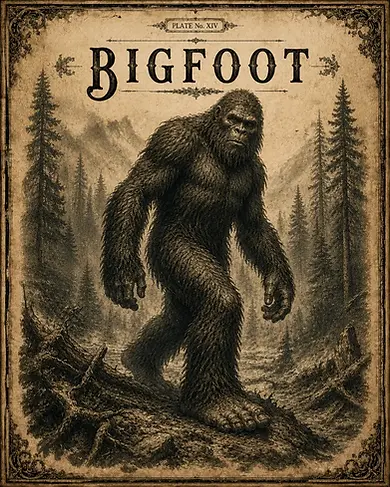
Bigfoot is generally described as a towering ape-like humanoid covered in dark hair.
Common characteristics include:
Height between 7–10 feet tall
Broad shoulders and heavily muscular frame
Long arms extending below the waist
Thick dark brown or black fur
Large human-like feet
Deep-set eyes and pronounced brow ridge
Witnesses often describe an overwhelming physical presence:
powerful odor
heavy footsteps
unnatural silence before sightings
and movement patterns surprisingly fast for a creature of its size
Despite its mass, Bigfoot appears highly adapted to forest movement and concealment.
Which raises uncomfortable questions about how many large things in the wilderness humans simply fail to notice regularly.

Field Profile
A quick-read threat assessment from the Legends of Myth creature archive.
Threat Class
Class II: Regional Threat
Best Known For
elusiveness, wilderness sightings, and immense physical strength
Danger Level
4/10
Strength
7/10
Intelligence
5/10
Magic Power
2/10
Speed / Mobility
6/10
Stealth / Ambush
8/10
Weakness Exploitability
5/10
Survival Difficulty
4/10
Creature Stats
Abilities & Powers
Extreme physical strength — capable of uprooting trees and moving large objects
Stealth movement — unusually difficult to track despite enormous size
Environmental camouflage — blends effectively into forest terrain
Enhanced endurance — traverses rough wilderness rapidly
Acute hearing and smell — highly aware of intruders
Possible intelligence and tool use — suggested in some eyewitness reports
Weaknesses
No confirmed supernatural durability — likely vulnerable to conventional injury
Isolation tendencies — often solitary or operating in small groups
Environmental dependence — strongest in dense wilderness terrain
Large resource requirements — enormous body size likely demands substantial food intake
Avoidance behavior — generally retreats rather than maintaining prolonged confrontation
Habitat

Bigfoot is most commonly associated with:
dense forests
mountainous wilderness
remote river valleys
isolated national parks
regions with limited human access
Sightings frequently occur in areas featuring:
heavy tree cover
poor visibility
minimal infrastructure
and people confidently hiking alone while saying things like “it’s probably just a bear”
Environmental indicators may include:
oversized footprints
broken branches at unusual heights
unexplained vocalizations
rock throwing
and sudden silence among surrounding wildlife
Bigfoot appears highly territorial but not consistently aggressive.
Most encounters end with observation rather than attack. Which is either reassuring or significantly more unsettling, depending on interpretation.
How to Defeat It
Historically, defeating Bigfoot has proven less difficult than proving Bigfoot exists conclusively.
If confrontation becomes unavoidable:
Maintain distance
Avoid dense forest pursuit
Do not separate from groups
Remain aware of surrounding terrain
Avoid escalating territorial behavior
Unlike predators driven purely by aggression, Bigfoot often appears more interested in warning intruders away than initiating lethal attacks.
That said, a creature capable of lifting logs while remaining largely undocumented should not be approached casually under any circumstances.
Especially by people carrying only a flashlight and misplaced confidence.
Could You Survive?
Probably.
Compared to creatures like Hydras, Wendigos, or Minotaurs, Bigfoot appears relatively non-hostile toward humans in most accounts. Your survival odds improve dramatically if:
you respect territorial boundaries
avoid provoking the creature
and resist following unexplained noises deeper into forests after dark
This final recommendation has historically been ignored at an astonishingly consistent rate.
Estimated survival odds: moderate to high, assuming common sense remains operational


Bigfoot FAQ
Is Bigfoot real?
No verified scientific evidence has confirmed the existence of Bigfoot. However, thousands of eyewitness reports, footprint discoveries, audio recordings, and alleged sightings have been reported across North America, keeping the mystery alive.
What is the difference between Bigfoot and Sasquatch?
There is no meaningful difference. "Bigfoot" and "Sasquatch" generally refer to the same creature. The name Sasquatch comes from the Salish word se'sxac, meaning "wild men," while Bigfoot became popular after reports of enormous footprints in California during the 1950s.
Where is Bigfoot most commonly seen?
Most reported sightings occur in the Pacific Northwest, British Columbia, Alaska, the Rocky Mountains, and other heavily forested regions of North America. Reports are typically concentrated in remote wilderness areas with dense tree cover and limited human activity.
How tall is Bigfoot supposed to be?
Most eyewitness descriptions place Bigfoot between 7 and 10 feet tall, with a broad chest, long arms, and a heavily muscular build. Some reports claim even larger sizes, though these accounts remain unverified.
What does Bigfoot eat?
According to folklore and eyewitness reports, Bigfoot is believed to be omnivorous. Alleged diets include berries, roots, nuts, fish, small game, and other foods available in remote wilderness environments.
Why are Bigfoot sightings so difficult to prove?
Supporters argue that Bigfoot's intelligence, stealth, and preference for remote habitats make it difficult to document. Skeptics counter that a breeding population of large primates should leave behind clear evidence such as bodies, bones, or DNA samples, none of which have been verified.
What is the Patterson-Gimlin Film?
The Patterson-Gimlin Film is a short 1967 video recorded at Bluff Creek, California, showing a large ape-like figure walking through the woods. It remains the most famous piece of alleged Bigfoot evidence and continues to be debated by believers and skeptics alike.
What are the most common signs of Bigfoot activity?
Reports frequently mention oversized footprints, unexplained vocalizations, wood knocks, rock throwing, unusual odors, broken branches, and sudden silence among wildlife before a sighting.
Could Bigfoot simply be a bear?
Many researchers believe a significant number of Bigfoot sightings can be explained by black bears standing upright, especially in low visibility conditions. Studies have found correlations between reported Bigfoot sightings and black bear populations across North America.
Are Bigfoot sightings still reported today?
Yes. New sightings continue to be reported every year throughout the United States and Canada. Databases such as the Bigfoot Mapping Project contain thousands of reports, and public interest remains remarkably strong.
Is Bigfoot dangerous?
Most reported encounters describe Bigfoot as elusive rather than aggressive. While some stories involve intimidation, rock throwing, or territorial behavior, very few accounts claim direct attacks on humans. According to folklore, Bigfoot generally prefers avoiding contact whenever possible.
Find out where Bigfoot ranks among the most dangerous cryptids.
What creatures are similar to Bigfoot?
The closest legendary relatives include the Yeti of the Himalayas, the Yowie of Australia, the Skunk Ape of the southeastern United States, and various "wild man" legends found throughout Indigenous traditions and global folklore.