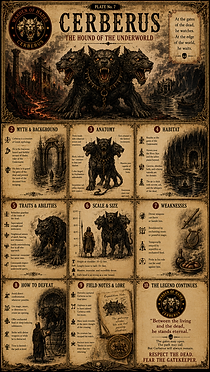
What is the Cerberus?
(Myth, Powers, Weaknesses & Origins)
Cerberus is one of the most recognizable creatures in Greek mythology—a massive multi-headed hound tasked with guarding the entrance to the Underworld. Most descriptions portray the creature with three heads, though some historical accounts claim far more. Which is concerning, because one head already presents enough logistical challenges for everyone involved.
Unlike many mythical beasts that wander forests or terrorize kingdoms, Cerberus serves a specific purpose: preventing the dead from leaving and the living from entering. It is less a predator and more a living security system designed by people with a very grim understanding of customer service.
Its reputation comes not only from its appearance, but from its role. Cerberus guards the boundary between life and death itself. And historically, very few creatures are placed at that door accidentally.

Origin & Mythology
Cerberus originates from Greek mythology and is most closely associated with the Underworld ruled by Hades.
According to Cerberus mythology, the creature was the offspring of:
-
Typhon
-
Echidna
Which, at this point in Greek mythology, should immediately tell you the situation will become unmanageable.
Cerberus appears in several major myths, most famously during the Twelve Labors of Heracles. As his final labor, Heracles was tasked with capturing Cerberus alive and bringing it out of the Underworld. Remarkably, he succeeded.
Though historical records are noticeably less detailed regarding how everyone involved emotionally processed that experience afterward.
Appearance & Anatomy
Cerberus is most commonly depicted as a gigantic black hound with three heads, though ancient sources vary considerably.
Common anatomical features include:
-
Three canine heads with independently aggressive behavior
-
Massive muscular frame
-
Black fur or scale-like hide
-
Eyes glowing red or ember-like in darkness
-
Serpentine tail
-
Venomous saliva capable of poisoning the ground
Some depictions also include:
-
snakes emerging from the creature’s back or neck
-
claws large enough to shred armor
-
unnatural vocalizations resembling layered growls or human screams
Its size varies between accounts, though nearly all descriptions agree that Cerberus is substantially larger than any natural canine species.
Which feels reasonable, given its assigned responsibilities.

Abilities & Powers
-
Multi-directional attack capability — multiple heads eliminate blind spots
-
Extreme physical strength — capable of overpowering heavily armed opponents
-
Supernatural endurance — rarely tires during combat
-
Territorial aggression — relentless when defending the Underworld
-
Fear induction — presence alone causes panic and paralysis in many mortals
-
Venomous saliva — toxic and corrosive in some mythological accounts
Weaknesses
-
Large target profile — difficult to conceal or maneuver in confined areas
-
Limited ranged capability — relies primarily on close combat
-
Head coordination limitations — multiple heads can occasionally conflict or overcommit
-
Music and sedation vulnerability — certain myths suggest calming methods may temporarily pacify the creature
-
Bound to territory — most effective near the Underworld itself
Habitat

Cerberus resides at the gates of the Underworld, typically near the rivers separating the living world from the dead.
Its environment is characterized by:
-
perpetual darkness
-
volcanic terrain
-
ash-covered ground
-
sulfuric air
-
extremely poor tourism potential
The creature appears highly territorial and rarely abandons its assigned post voluntarily.
Unlike roaming predators, Cerberus operates as a guardian organism. Its behavior is less focused on hunting and more on containment:
-
preventing escape
-
deterring intrusion
-
and ensuring boundaries remain exactly where the gods intended them to be
How to Defeat It
Historically, defeating Cerberus outright is exceptionally rare. Most successful encounters involve:
-
avoidance
-
distraction
-
sedation
-
or divine-level strength
Direct combat presents several problems:
-
Multiple simultaneous attack angles
-
Extreme bite force
-
Near-relentless aggression once provoked
If engagement becomes unavoidable:
-
maintain mobility
-
avoid being cornered
-
target sensory organs rather than armored muscle
-
and under no circumstances allow all three heads to coordinate a charge simultaneously
Ancient accounts also suggest music, enchanted food, or magical sleep can pacify the creature temporarily. Which raises complicated questions about whether Cerberus is fundamentally a monster or simply an extremely overworked dog.
Could You Survive?
Possibly. But the context is important.
If you encounter Cerberus casually, you are almost certainly already somewhere you should not be.
Survival odds improve significantly if:
-
you do not attempt entry into the Underworld
-
you avoid provoking territorial behavior
-
and you are not currently classified as “escaping soul”
Which historically has proven difficult for a surprising number of people.
Estimated survival odds: extremely low near the Underworld gates
Related Creatures



Own the Cerberus
Click below to get your own Cerberus Infographic poster.