

What is El Chupacabra?
(Myth, Powers, Weaknesses & Origins)
El Chupacabra is one of the most infamous cryptids in modern folklore—a nocturnal predator blamed for livestock deaths, unexplained blood loss, and a deeply concerning number of eyewitness accounts that begin with the phrase: “I know what I saw.”
Unlike ancient mythological creatures rooted in temples and epics, the Chupacabra belongs to something more recent and arguably more unsettling: modern urban legend. Reports of the creature spread rapidly across Puerto Rico and Latin America during the late 20th century, where farmers described animals discovered drained of blood with strange puncture wounds and little evidence of struggle.
Whether cryptid, misidentified predator, or something considerably harder to explain, El Chupacabra occupies a unique place in creature lore. It is not ancient enough to feel symbolic. It is recent enough to feel possible.
Which, historically speaking, tends to keep people awake longer.

Origin & Mythology
El Chupacabra originates primarily from modern folklore in Puerto Rico during the 1990s.
The name translates roughly to: “goat sucker.”
Which, while direct, does leave little room for positive interpretation.
According to Chupacabra mythology and eyewitness reports, the creature was first linked to mysterious livestock attacks in rural communities. Goats, chickens, and other animals were discovered dead with:
-
puncture wounds to the neck or chest
-
apparent blood loss
-
minimal signs of predation
As stories spread across Latin America and the southern United States, descriptions of the creature evolved. Some witnesses described:
-
reptilian humanoids with spines
-
hairless canine-like predators
and some accounts became increasingly difficult to separate from panic, rumor, or exhausted people investigating strange noises at 2:00 AM - which is not traditionally the peak hour for objective scientific observation.
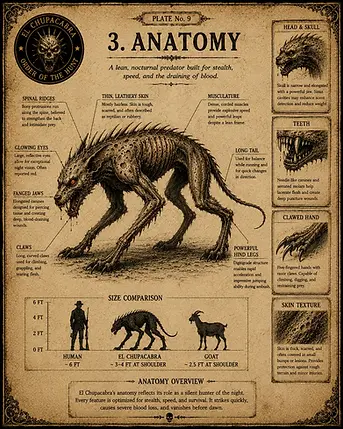
Appearance & Anatomy
Descriptions of El Chupacabra vary significantly, though two
dominant versions appear most frequently.
Reptilian Variant
-
Lean humanoid frame
-
Dark or gray skin
-
Spines running along the back
-
Glowing red or orange eyes
-
Clawed hands and feet
Canine Variant
-
Hairless dog-like body
-
Elongated snout
-
Prominent teeth or fangs
-
Diseased or leathery skin
-
Thin but muscular limbs
Both forms are commonly described as:
-
unnaturally fast
-
nocturnal
-
silent during movement
-
and deeply unpleasant to encounter unexpectedly in farmland conditions
Abilities & Powers
-
Extreme stealth — capable of approaching livestock unnoticed
-
Nocturnal hunting adaptation — operates primarily at night
-
Rapid movement — difficult to track visually
-
Enhanced predatory senses — acute hearing and smell
-
Psychological fear response — induces panic in animals and witnesses
-
Possible blood-feeding behavior — central trait in most reports
Weaknesses
-
Physically smaller than major mythological beasts — vulnerable to direct force
-
Light sensitivity — primarily active at night
-
Limited endurance in prolonged combat — relies heavily on ambush tactics
-
Potential territorial predictability — often returns to feeding regions
-
No confirmed supernatural durability — unlike creatures such as Hydras or Phoenixes
Habitat
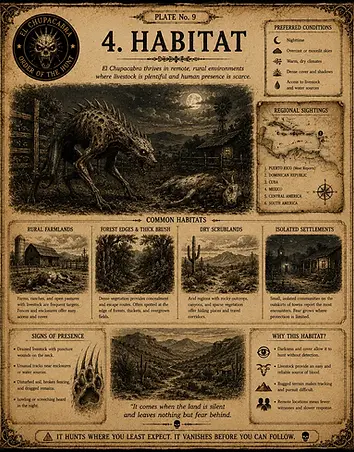
El Chupacabra is most commonly associated with:
-
rural farmland
-
forests near livestock regions
-
desert outskirts
-
isolated villages
-
and areas where people say things like “the animals have been acting strange lately” immediately before making very poor investigative decisions
Sightings frequently occur in:
-
Puerto Rico
-
Mexico
-
Central America
-
the southwestern United States
The creature appears to prefer:
-
low-light environments
-
minimal human activity
-
easy access to livestock or small prey animals
Unlike territorial monsters guarding a fixed location, the Chupacabra behaves more like a roaming predator.
How to Defeat It
Compared to ancient mythological creatures, El Chupacabra is theoretically survivable. This is encouraging.
Historically, however, people become significantly less tactical when confronting glowing-eyed predators in darkness.
Effective strategies include:
-
Avoid isolated investigation at night
-
Maintain perimeter lighting around livestock
-
Use ranged weapons if confrontation becomes unavoidable
-
Avoid dense brush or enclosed terrain
-
Track movement patterns rather than pursuing blindly
The Chupacabra relies heavily on:
-
surprise
-
speed
-
and fear-based confusion
Removing those advantages dramatically improves survival odds.
Though admittedly, “stay calm while the cryptid watches you from the tree line” is easier advice to write than implement.
Could You Survive?
Possibly. Unlike creatures such as the Hydra or Kraken, the Chupacabra does not possess overwhelming scale or supernatural invulnerability.
That said:
-
it attacks at night
-
avoids detection
-
and appears most often in isolated areas where assistance is limited
Which are not ideal environmental conditions for maintaining confidence.
Your survival odds improve substantially if:
-
you avoid pursuing unexplained sounds
-
you remain indoors after sightings
-
and you resist the deeply human instinct to “just go check real quick.”
Estimated survival odds: moderate if prepared, poor if curious
Related Creatures



Own El Chupacabra
Click below to get your own Chupacabra Infographic poster.
