
What is the Leviathan?
(Myth, Powers, Weaknesses & Origins)
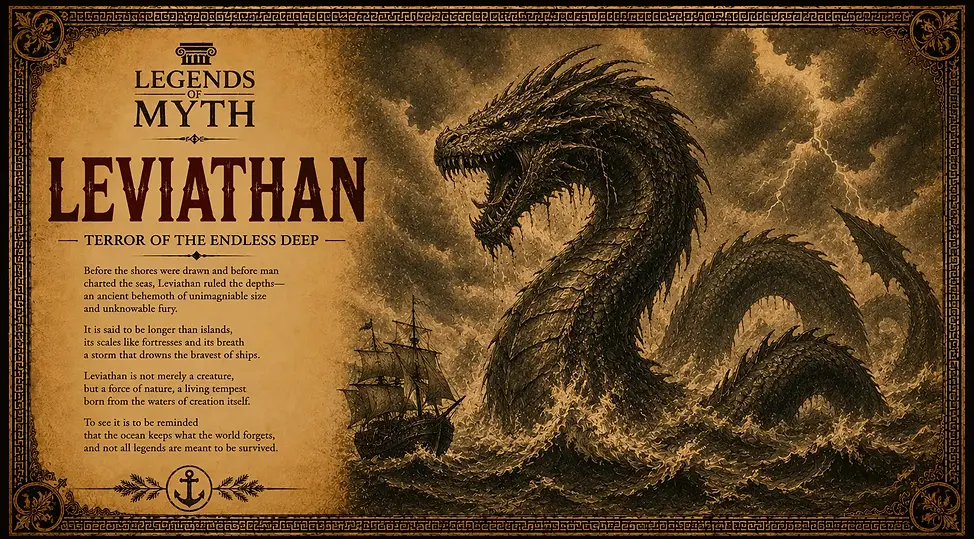
Leviathan is one of the largest and most terrifying creatures in mythology—a colossal sea beast associated with chaos, storms, and the raw, untamed power of the ocean itself.
Unlike the Kraken, which attacks ships, or sea serpents that haunt coastlines, Leviathan is often portrayed as something far greater. It is not merely a monster living in the sea. In many traditions, it is the embodiment of the sea's destructive potential.
Ancient texts describe a creature so immense that nations feared it, sailors prayed against it, and entire civilizations used it as a symbol for forces beyond human control.
Which, considering humanity's historical relationship with the ocean, is saying something.
When Leviathan appears in mythology, it rarely functions as an animal.
It functions as a warning.
Origin & Mythology
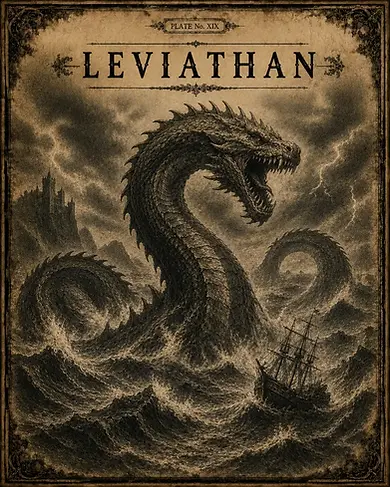
Leviathan originates primarily from Biblical mythology and ancient Near Eastern traditions.
The creature appears most famously in the Book of Job, where it is described as an enormous sea beast beyond human power to tame or defeat.
Biblical descriptions portray Leviathan as:
unstoppable
heavily armored
terrifying in appearance
capable of inspiring fear even among the mighty
Over time, Leviathan became associated with:
chaos
the primordial ocean
divine judgment
cosmic conflict
Some traditions portray Leviathan as a literal creature. Others interpret it symbolically.
Neither interpretation makes it significantly less intimidating.
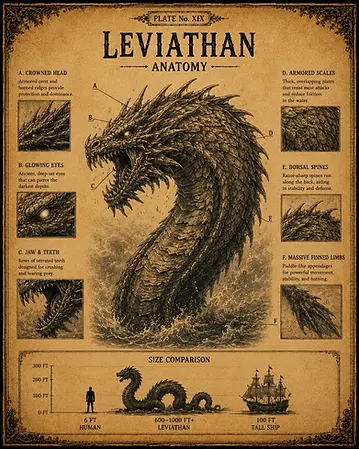
Appearance & Anatomy
Descriptions of Leviathan vary, though most accounts portray a gigantic serpentine or dragon-like sea creature.
Common characteristics include:
Massive elongated body
Impenetrable scales
Enormous jaws lined with teeth
Glowing eyes
Serpentine neck
Powerful tail capable of generating enormous waves
Some accounts describe Leviathan as:
dragon-like
crocodilian
whale-like
or a combination of all three
Its exact dimensions are rarely specified. This is likely because "too large to reasonably comprehend" is difficult to convert into measurements.
Field Profile
A quick-read threat assessment from the Legends of Myth creature archive.
Threat Class
Class V: Legendary Calamity
Best Known For
cosmic sea power, overwhelming size, and primordial destruction
Danger Level
10/10
Strength
10/10
Intelligence
7/10
Magic Power
9/10
Speed / Mobility
7/10
Stealth / Ambush
6/10
Weakness Exploitability
2/10
Survival Difficulty
10/10
Creature Stats
Abilities & Powers
Colossal size — among the largest creatures in mythology
Oceanic dominance — controls vast regions of sea
Extreme durability — scales resistant to conventional weapons
Storm generation — associated with violent weather and turbulent seas
Massive physical strength — capable of destroying ships effortlessly
Psychological terror — inspires fear simply through appearance
Near-mythic resilience — survives encounters that would destroy lesser creatures
See our in-depth guide for more on Leviathan abilities.
Weaknesses
Limited terrestrial mobility — strongest within aquatic environments
Enormous size — difficult to conceal or maneuver in confined areas
Dependency on ocean ecosystems — adapted primarily to marine environments
Mythological vulnerability to divine intervention — often defeated only through supernatural means
Predictable territorial behavior — tied to specific bodies of water in some traditions
Habitat

Leviathan inhabits:
deep oceans
primordial seas
unexplored waters
mythological oceanic realms
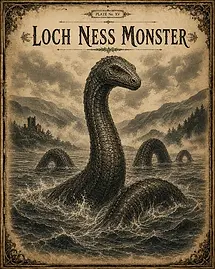
Unlike Nessie or other localized water cryptids, Leviathan is not tied to a single lake or coastline.
It represents the sea itself.
Environmental signs often associated with Leviathan activity include:
massive storms
unusual tidal activity
unexplained disappearances at sea
violent ocean disturbances
Ancient sailors frequently attributed catastrophic maritime events to creatures like Leviathan.
To be fair, if a giant sea dragon emerged from the depths during a storm, accurate record-keeping would likely become a secondary priority.
How to Defeat It
Historically? You don't.
Many traditions describe Leviathan as effectively beyond human ability to defeat through conventional means.
If confrontation became unavoidable:
Leave the area immediately
Continue leaving the area
Reconsider why you approached a primordial sea monster in the first place
Most successful mythological encounters involve:
divine intervention
legendary heroes with supernatural assistance
cosmic-scale conflict
Direct combat by ordinary humans is generally omitted from surviving accounts. Possibly because there were no surviving accounts.
Could You Survive?
Theoretically.
Realistically, survival depends entirely on distance.
If you observe Leviathan from:
a coastline → perhaps
a distant vessel → maybe
the deck of a ship directly beneath it → considerably less maybe
Unlike predators that hunt individuals, Leviathan threatens entire vessels and environments simultaneously.
At that scale, personal survival becomes largely a matter of geography.
Estimated survival odds: extremely low at sea, significantly better on another continent



Frequently Asked Questions About the Leviathan
What is the Leviathan in mythology?
The Leviathan is a legendary sea monster that appears in ancient Hebrew texts and later religious traditions. It is typically described as a colossal serpent or dragon-like creature that dwells in the deepest parts of the ocean and symbolizes chaos, power, and the untamable forces of nature.
Is the Leviathan mentioned in the Bible?
Yes. The Leviathan appears several times in the Hebrew Bible, most notably in the Book of Job. There, it is described as a creature of immense strength that no ordinary human can defeat. Biblical descriptions emphasize its power, scales, and terrifying presence.
How big is the Leviathan?
Ancient texts do not provide exact measurements, but the Leviathan is consistently portrayed as enormous. Modern interpretations often depict it as hundreds of feet long, large enough to dwarf ships and create massive waves simply by moving through the water.
What powers does the Leviathan have?
The Leviathan is commonly associated with immense physical strength, near-invulnerable scales, control over the sea, storm creation, supernatural endurance, and the ability to inspire fear. In many traditions, it is considered a threat beyond the capability of ordinary humans to overcome.
Is the Leviathan a dragon?
Sometimes. Depending on the source, the Leviathan may be described as a giant sea serpent, a dragon-like beast, or a combination of both. Many modern depictions portray it as an aquatic dragon with armored scales, massive jaws, and immense size.
What is the difference between Leviathan and Kraken?
The Leviathan is usually depicted as a colossal serpent or dragon associated with biblical and ancient traditions. The Kraken originates from Scandinavian folklore and is typically portrayed as a gigantic tentacled sea creature. Both are legendary sea monsters, but their origins and appearances differ significantly.
Could the Leviathan defeat the Kraken?
There is no definitive answer because both creatures exist in mythology rather than a single shared legend. The Leviathan generally possesses greater size, durability, and symbolic power, while the Kraken relies on tentacles and ambush tactics. The outcome depends on which version of each creature is being compared.
What are the Leviathan's weaknesses?
Most myths portray the Leviathan as nearly invincible. Its few potential weaknesses include divine intervention, supernatural weapons, or destiny itself. Unlike many monsters, it is rarely shown having a simple physical vulnerability that a hero can exploit.
Is Leviathan based on a real animal?
Some scholars believe stories of the Leviathan may have been inspired by crocodiles, whales, giant sea serpents, or the fear of unknown creatures beneath the ocean's surface. However, the Leviathan itself is a mythological being rather than a documented animal.
Is the Leviathan evil?
Not necessarily. In many traditions, the Leviathan is less a villain and more a force of nature. It represents chaos, power, and the wildness of creation. Like a storm or the ocean itself, it can be destructive without being inherently malicious.
Where does the Leviathan live?
The Leviathan is traditionally said to inhabit the deepest parts of the ocean, including trenches, abyssal depths, and uncharted waters. Legends often describe it emerging only during great storms or significant cosmic events.
What creatures are similar to the Leviathan?
Several legendary creatures share similarities with the Leviathan, including the Kraken, Jörmungandr, Hydra, and various sea serpents found throughout world mythology. Each represents humanity's fascination with enormous and mysterious creatures lurking beneath the water.