

What is the Loch Ness Monster?
(Myth, Powers, Weaknesses & Origins)
The Loch Ness Monster is one of the most famous cryptids in the world—a mysterious aquatic creature said to inhabit the deep waters of Loch Ness in the Scottish Highlands. Known affectionately as "Nessie," the creature has inspired nearly a century of sightings, investigations, debates, and photographs ranging from compelling to aggressively unhelpful.
Unlike dragons, hydras, or sea serpents, the Loch Ness Monster is unusual because its legend remains rooted in a specific location. It does not roam oceans or terrorize civilizations. It simply remains in the same lake, quietly refusing to explain itself.
This persistence has transformed Nessie from a local legend into a global phenomenon.
For nearly a hundred years, people have searched for evidence. Sonar scans have been conducted. Expeditions have been launched. Experts have weighed in.
And Loch Ness continues to answer every question with the same response: perhaps.

Origin & Mythology
The Loch Ness Monster originates from folklore surrounding Loch Ness in Scotland.
One of the earliest recorded references appears in the sixth century, when Saint Columba reportedly encountered a "water beast" in the River Ness.
The modern legend began in 1933 after multiple highly publicized sightings described a large creature moving through the lake.
Soon afterward came the famous "Surgeon's Photograph," an image that helped define public perception of Nessie for decades before later being revealed as a hoax.
Remarkably, this did little to slow public fascination. Most cryptids disappear after being exposed. Nessie simply continued receiving visitors.
Appearance & Anatomy
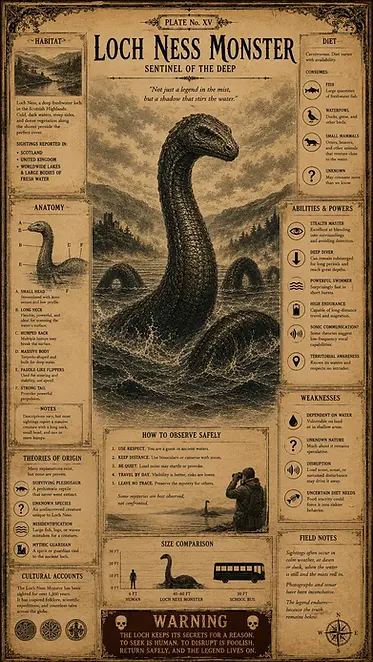
Descriptions of the Loch Ness Monster vary, but several features appear repeatedly across eyewitness accounts.
Common characteristics include:
Long serpentine neck
Small head relative to body size
Large submerged torso
Dark gray or brown coloration
One or more humps visible above water
Powerful tail adapted for aquatic propulsion
Many descriptions resemble prehistoric marine reptiles, particularly plesiosaurs.
Whether this reflects reality, cultural influence, or the human tendency to recognize familiar shapes in distant objects remains heavily debated. The creature is rarely observed fully above water, which has contributed significantly to both its mystery and its public relations strategy.

Field Profile
A quick-read threat assessment from the Legends of Myth creature archive.
Threat Class
Class II: Regional Threat
Best Known For
mysterious lake sightings and hidden movement beneath deep water
Danger Level
5/10
Strength
8/10
Intelligence
4/10
Magic Power
3/10
Speed / Mobility
6/10
Stealth / Ambush
8/10
Weakness Exploitability
5/10
Survival Difficulty
5/10
Creature Stats
Abilities & Powers
Aquatic stealth — capable of remaining hidden beneath the surface for extended periods
Exceptional swimming ability — navigates deep freshwater environments efficiently
Environmental concealment — benefits from dark, murky water conditions
Extreme evasiveness — consistently avoids definitive documentation
Long-term survival potential — sightings suggest remarkable longevity if real
Psychological influence on observers — encourages immediate photography attempts regardless of equipment quality
Weaknesses
Restricted habitat — confined to Loch Ness
Limited terrestrial mobility — poorly suited for movement on land
Reliance on concealment — visibility reduces its primary advantage
Large body size — requires substantial food resources if biological
Potential vulnerability to modern tracking technology — though evidence remains inconclusive
Habitat

The Loch Ness Monster is exclusively associated with Loch Ness, one of the deepest freshwater lakes in Europe.
The lake provides ideal conditions for concealment:
Great depth
Dark water caused by peat content
Low underwater visibility
Extensive underwater terrain and drop-offs
Environmental conditions frequently associated with sightings include:
fog
low light
calm water suddenly disturbed by movement
and tourists becoming increasingly convinced that every ripple deserves immediate analysis
Unlike many cryptids, Nessie appears remarkably loyal to its habitat.
Or perhaps simply aware that relocating would create paperwork.
How to Defeat It
Assuming the Loch Ness Monster exists, defeating it would first require locating it reliably. This has proven challenging.
Historically, the creature demonstrates:
avoidance behavior
minimal aggression toward humans
strong preference for remaining underwater
If confrontation somehow became necessary:
Maintain visual contact
Utilize sonar and tracking technology
Avoid entering the water unnecessarily
Prevent escape into deep sections of the lake
Remain skeptical of sudden photographic certainty
Unlike Krakens or sea serpents, Nessie does not appear interested in attacking vessels or humans directly.
The primary challenge is less survival and more verification.
Could You Survive?
Almost certainly.
The Loch Ness Monster is one of the few legendary creatures whose greatest threat is not physical danger, but obsession.
From a direct encounter perspective, however, Nessie appears remarkably polite. At least compared to most creatures featured in this archive.
Estimated survival odds: very high


Loch Ness Monster FAQ
What is the Loch Ness Monster?
The Loch Ness Monster, often called "Nessie," is a legendary creature said to inhabit Loch Ness, a deep freshwater lake in the Scottish Highlands. Most descriptions portray Nessie as a large aquatic animal with a long neck, small head, and several humps visible above the water's surface.
Is the Loch Ness Monster real?
There is no scientific evidence proving the Loch Ness Monster exists. Numerous sonar surveys, underwater searches, photography expeditions, and DNA studies have failed to confirm the presence of a large unknown animal in Loch Ness. However, reported sightings continue to fuel the mystery.
When was the first Loch Ness Monster sighting?
The most famous modern sightings began in 1933, when reports of a large creature in Loch Ness gained widespread media attention. Earlier stories of mysterious water beasts in the area date back centuries and are often connected to local folklore and the account of Saint Columba in the 6th century.
How many Loch Ness Monster sightings have been reported?
More than 1,000 reported sightings have been recorded over the years. New reports still emerge, often accompanied by photographs, videos, sonar readings, or eyewitness accounts.
What does the Loch Ness Monster look like?
Descriptions vary, but Nessie is commonly depicted as a large, dark creature with a long neck, small head, broad body, and one or more humps visible above the water. This appearance has led many people to compare it to a prehistoric marine reptile.
Could the Loch Ness Monster be a dinosaur?
The most popular theory is that Nessie is a surviving plesiosaur, a marine reptile that lived during the age of dinosaurs. However, scientists note that there is no fossil, DNA, or ecological evidence supporting this idea, and modern studies have found no signs of a large reptilian species in the loch.
What did the DNA study of Loch Ness find?
A major environmental DNA (eDNA) survey collected samples from around Loch Ness and found no evidence of large reptiles, sharks, sturgeon, or unknown giant animals. Researchers did, however, find a significant amount of eel DNA, leading to speculation that unusually large eels could explain some sightings.
Have sonar searches ever found Nessie?
Several sonar expeditions have detected large unidentified objects or unusual underwater movements, but none have provided conclusive evidence of a monster. Most sonar anomalies have eventually been attributed to fish, debris, seals, or other natural phenomena.
What is the most famous Loch Ness Monster photograph?
The most famous image is the 1934 "Surgeon's Photograph," which appeared to show a long-necked creature emerging from the water. Decades later, it was revealed to be a hoax involving a small model. Despite this, it remains one of the most iconic cryptid photographs ever taken.
Why does the Loch Ness Monster remain so popular?
Nessie combines everything that makes a great mystery: eyewitness sightings, unexplained photographs, scientific investigations, centuries of folklore, and the possibility that something unknown could still lurk beneath the surface. Even without proof, the legend continues to capture imaginations around the world.
Can you visit Loch Ness?
Yes. Loch Ness is one of Scotland's most visited destinations. Visitors can explore the loch, tour historic sites such as Urquhart Castle, take boat cruises, visit local museums, and even participate in modern monster-hunting events and surveys.
What is the most likely explanation for Nessie?
The leading explanations include misidentified animals, large eels, waves, floating logs, optical illusions, hoaxes, and mistaken sightings of known wildlife. While no single theory explains every report, most researchers believe natural causes are responsible for the majority of sightings.