
What is the Chimera?
(Myth, Powers, Weaknesses & Origins)
The Chimera is one of the most terrifying hybrid creatures in Greek mythology—a fire-breathing predator composed of multiple animals fused into a single unnatural organism.
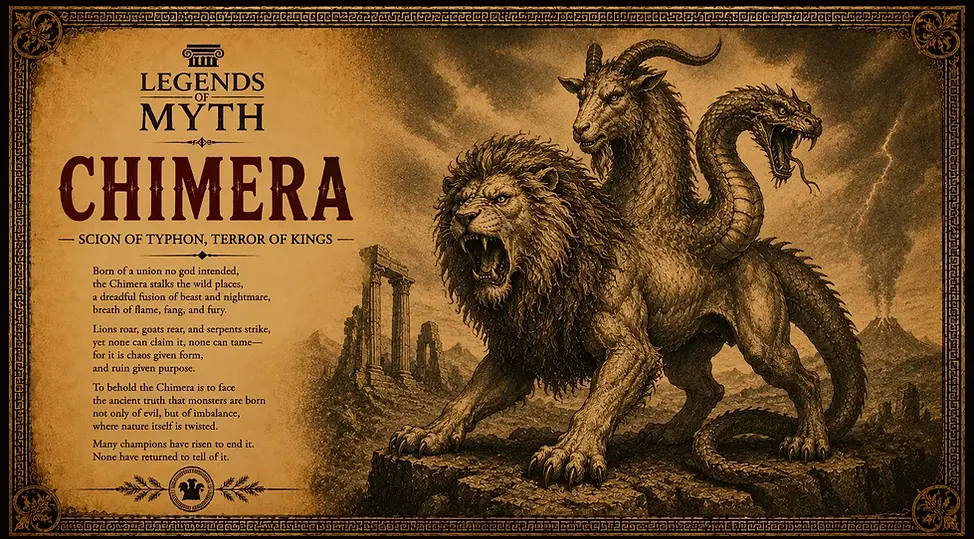
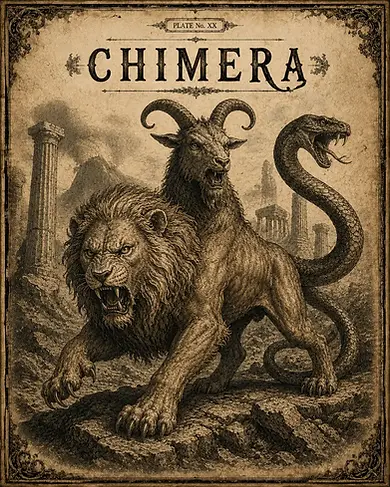
Unlike the Griffin, whose hybrid anatomy feels almost elegant, the Chimera appears deliberately wrong. Ancient descriptions combine the body of a lion, the head of a goat emerging from its back, and a serpent for a tail. Individually, each animal is dangerous. Together, they create something that seems less like a creature and more like a disagreement between nature and reason.
The Chimera became a symbol of chaos, destruction, and impossible threats. It is the mythological equivalent of asking, “What if one apex predator wasn’t enough?”
Historically, the answer was not encouraging.
Origin & Mythology
The Chimera originates from Greek mythology and is most closely associated with the region of Lycia.
According to Chimera mythology, the creature was the offspring of two infamous monsters:
Typhon
Echidna
This pairing has produced:
Orthrus
and several other entries in the archive that consistently fail basic safety inspections.
The Chimera terrorized the countryside of Lycia until the hero Bellerophon confronted it while riding the winged horse Pegasus.
Unlike many heroes who relied primarily on courage, Bellerophon wisely recognized that approaching a fire-breathing hybrid monster on foot was unlikely to improve the situation.
Appearance & Anatomy
The Chimera possesses one of the most distinctive anatomies in mythology.
Common descriptions include:
Lion's body and primary head
Goat head emerging from the creature's back
Serpentine tail ending in a living snake head
Massive claws and muscular forelimbs
Scaled and fur-covered body sections
Burning breath capable of igniting surrounding terrain
Unlike many mythical creatures, the Chimera's multiple heads appear to function independently.
This presents several tactical concerns. Most notably: while one head is attempting to bite you, another may be breathing fire, and the third may simply be evaluating alternative approaches.

Field Profile
A quick-read threat assessment from the Legends of Myth creature archive.
Threat Class
Class IV: Catastrophic Entity
Best Known For
hybrid anatomy, fire-breathing, and multi-threat attacks
Danger Level
9/10
Strength
9/10
Intelligence
4/10
Magic Power
7/10
Speed / Mobility
7/10
Stealth / Ambush
5/10
Weakness Exploitability
4/10
Survival Difficulty
9/10
Creature Stats
Abilities & Powers
Fire breathing — capable of projecting intense flames
Multi-directional attacks — multiple heads eliminate blind spots
Extreme physical strength — powerful enough to overpower large prey
Venomous serpent tail — additional close-range threat
Territorial aggression — attacks intruders relentlessly
High combat adaptability — combines several predatory strategies simultaneously
Weaknesses
Internal anatomical complexity — multiple systems create coordination challenges
Large target profile — difficult to conceal or maneuver in confined terrain
Predictable aggression — often charges directly into conflict
Reliance on physical proximity — most dangerous at close range
Vulnerability to aerial attacks — historical accounts suggest elevation reduces its advantages
Habitat

The Chimera is most commonly associated with:
rugged mountains
volcanic regions
rocky highlands
isolated wilderness areas
Ancient accounts frequently place the creature near:
caves
cliffs
regions scarred by fire
Environmental signs of Chimera activity may include:
scorched vegetation
unusual animal disappearances
burned terrain without obvious cause
and the growing realization that the "strange lion" appears to have exceeded the recommended number of heads
The Chimera is highly territorial and appears unwilling to share hunting grounds with other large predators.
This position is generally respected.
How to Defeat It
The first rule: do not fight the Chimera where it wants to fight you.
The creature excels in close-range combat and can attack from multiple angles simultaneously.
Historically effective strategies include:
Maintaining distance
Using elevated positions
Exploiting aerial mobility where possible
Avoiding prolonged engagement
Targeting the creature before it closes distance
According to mythology, Bellerophon ultimately defeated the Chimera by attacking from the air while riding Pegasus.
This suggests two important lessons:
Distance matters.
Winged horses improve many tactical situations.
Could You Survive?
Your survival odds depend heavily on preparation.
If you encounter the Chimera unexpectedly: poor
If you deliberately hunt the Chimera: just as poor
The creature combines:
fire
venom
claws
overwhelming strength
Most predators specialize. The Chimera appears to have viewed specialization as an unnecessary limitation.
Estimated survival odds: extremely low


Frequently Asked Questions About the Chimera
What is the Chimera in Greek mythology?
The Chimera is a legendary monster from Greek mythology described as a hybrid creature with the body and head of a lion, a goat's head rising from its back, and a serpent for a tail. Ancient sources also describe the Chimera as breathing fire, making it one of the most dangerous monsters in the Greek world.
What does the Chimera look like?
The Chimera combines three animals into a single terrifying creature:
Lion head and body
Goat head emerging from its back
Serpent or dragon tail
Many artistic depictions emphasize the lion as the dominant head, while the goat and serpent provide additional attacks and supernatural abilities.
Who were the Chimera's parents?
According to Greek mythology, the Chimera was the offspring of Typhon and Echidna, two primordial monsters responsible for many of the deadliest creatures in myth. Its siblings include Cerberus, the Hydra, Orthrus, and several other legendary beasts.
Where did the Chimera live?
The Chimera was said to inhabit Lycia, an ancient region located in what is now southwestern Turkey. Ancient writers described it roaming rocky mountains, remote valleys, and wilderness regions where few people dared to travel.
Could the Chimera breathe fire?
Yes. Fire-breathing is one of the Chimera's defining traits. Homer, Hesiod, and later Greek authors all describe the creature as capable of unleashing blazing fire from its body, making it even more deadly than ordinary beasts.
Who killed the Chimera?
The hero Bellerophon is credited with slaying the Chimera. Riding the winged horse Pegasus, he attacked from the air to avoid the monster's flames and ferocious attacks. In the most famous version of the story, he used a lead-tipped spear that melted inside the Chimera's throat when exposed to its fire, ultimately killing the beast.
What powers did the Chimera have?
The Chimera possessed several legendary abilities:
Fire breathing
Incredible strength
Multiple heads capable of attacking simultaneously
Venomous serpent tail
Exceptional speed and endurance
Fear-inducing appearance
These traits made it one of the most feared monsters in Greek mythology.
What does the Chimera symbolize?
The Chimera often symbolizes chaos, destruction, and the untamed forces of nature. Because it combines multiple animals into one impossible creature, it also represents unnatural combinations, confusion, and overwhelming threats that require ingenuity rather than brute force to defeat.
Was the Chimera based on a real animal?
There is no evidence that the Chimera was a real creature. Some historians believe the legend may have been inspired by natural gas vents in ancient Lycia that continuously burned from the mountainside. Ancient travelers may have associated these mysterious fires with a fire-breathing monster.
Is the Chimera a dragon?
Not exactly. The Chimera is considered a hybrid monster rather than a true dragon. However, its serpent tail, fire-breathing abilities, and monstrous appearance often place it alongside dragons in mythology and fantasy.
What is the difference between a Chimera and a Manticore?
A Chimera is a lion-goat-serpent hybrid from Greek mythology, while a Manticore is typically depicted as a lion with a human face and a scorpion tail. Both are hybrid creatures, but they come from different mythological traditions and possess different abilities.
Why is the Chimera still famous today?
The Chimera remains popular because it combines several things people find fascinating:
Hybrid monsters
Greek mythology
Fire-breathing creatures
Epic hero battles
Symbolic meaning
Its influence can be seen in fantasy novels, role-playing games, movies, video games, and modern monster design.