

The Offspring of Typhon
Cerberus. Hydra. Chimera. Three monsters. One catastrophic family tree.
Before Greek heroes could prove themselves, Greek mythology had to provide something worth surviving.
Enter Typhon and Echidna.

Together, they became the most infamous parents in the monster business: a storm-born giant and a serpent-bodied mother of monsters whose children guarded the dead, terrorized marshlands, breathed fire, multiplied when attacked, and generally made ancient Greece a deeply inconvenient place to own sandals.
Among their most famous offspring were three creatures that became legends in their own right:
Cerberus

The Lernaean Hydra

The Chimera

Each one represented a different kind of terror. Each one became tied to a hero’s trial. And each one proved that in Greek mythology, family resemblance had less to do with appearance and more to do with how many people fled screaming.
Who Were Typhon and Echidna?
Typhon was one of the most terrifying beings in Greek mythology. Often described as a monstrous giant associated with storms, chaos, volcanic force, and rebellion against the gods, he was powerful enough to challenge Zeus himself.
Echidna, his mate, was a half-woman, half-serpent figure remembered as the Mother of Monsters. Where Typhon represented overwhelming force, Echidna represented the monstrous bloodline itself: the source from which many of Greek mythology’s deadliest creatures emerged.
Together, Typhon and Echidna produced a family tree that reads less like genealogy and more like a warning label.
Their children are traditionally said to include several of the most dangerous beings in Greek myth, including Cerberus, Hydra, Chimera, Orthrus, and in some traditions, other legendary monsters such as the Sphinx, the Nemean Lion, Ladon, or the Caucasian Eagle.
But Cerberus, Hydra, and Chimera stand out because each became a defining monster of Greek heroic legend.
Cerberus guarded the boundary between life and death.
Hydra punished direct attack by becoming worse.
Chimera embodied nature broken into something impossible.
Together, they form one of mythology’s most dangerous sibling groups. A normal family reunion would be unwise.

Cerberus:
The Hound of Hades
Role:
Guardian
Domain:
The Underworld
Threat Type:
Boundary control
Hero Encounter:
Heracles
Best Known For:
Guarding the gates of Hades
Cerberus was the monstrous hound of the Underworld, stationed at the gates of Hades to prevent the dead from leaving and the living from entering without permission.
He is usually described as a three-headed dog, though some ancient accounts gave him far more heads. Serpents were sometimes said to grow from his body, and his tail was often imagined as a snake. Subtle, apparently, was not a major design principle in Greek monster anatomy.
Unlike many monsters, Cerberus was not simply roaming the countryside looking for victims. He had a job.
He guarded a threshold.
That makes him one of the most interesting of Typhon’s offspring. Cerberus was dangerous, but not chaotic in the same way as Hydra or Chimera. He was a monster with a function. A gatekeeper. A living warning at the edge of the afterlife.
His message was simple:
-
You do not pass.
-
You do not return.
-
And if you attempt either, the dog will have several opinions.
Why Cerberus Matters
Cerberus represents the boundary between the living and the dead. He is not merely a beast. He is a cosmic security system with teeth.
In the myths of Heracles, Cerberus becomes the final labor: the impossible task of descending into the Underworld and bringing the hound back alive. Unlike Hydra, who had to be killed, Cerberus had to be subdued. That distinction matters.
Cerberus was not a mistake in the world. He was part of its order.
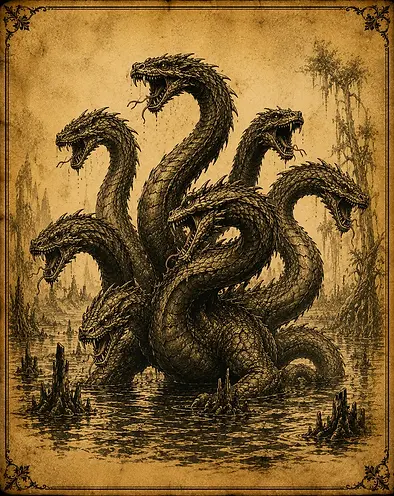
Hydra:
The Multi-headed serpent Problem
Role:
Trial monster
Domain:
The marshes of Lerna
Threat Type:
Regeneration and escalation
Hero Encounter:
Heracles
Best Known For:
Growing back more heads when one was cut off
The Lernaean Hydra was one of the most infamous monsters in Greek mythology: a many-headed serpent that lived in the swamps near Lerna.
Its defining feature was not simply that it had multiple heads. That would already be enough of a problem. The true horror of the Hydra was that cutting off one head could cause more to grow back in its place.
In other words, the Hydra punished the obvious solution.
Attack without understanding made the situation worse.
This is what separates Hydra from a simple serpent or dragon-like creature. Hydra is not just dangerous because it is large, venomous, or difficult to kill. Hydra is dangerous because it changes the rules of conflict.
Most monsters ask, “Can you defeat me?” Hydra asks, “Can you defeat me without making me stronger?”
This is a rude question.
Why Hydra Matters
Hydra represents escalation. It is the mythological version of a problem that multiplies when attacked directly.
That makes Heracles’ battle with Hydra especially important. He could not defeat the monster through brute force alone. He needed strategy, help, and a method for stopping the heads from regenerating.
Depending on the version of the myth, Heracles and his nephew Iolaus cauterized the severed necks to prevent new heads from growing. The immortal head was then buried beneath a rock.
A solution, yes.
Elegant, no.
But when facing a regenerating swamp serpent, elegance is rarely the first priority.

Chimera:
The Beast That Should Not Work
Role:
Hybrid monster
Domain:
Lycia
Threat Type:
Fire, contradiction, and impossible anatomy
Hero Encounter:
Bellerophon
Best Known For:
Lion body, goat head, serpent tail, and fire-breathing
The Chimera was one of Greek mythology’s most unnatural creatures, usually described as a fire-breathing hybrid with the body of a lion, the head or body of a goat, and a serpent for a tail.
It was not simply a dangerous animal. It was several dangerous animals having a disagreement about structure.
The Chimera’s power came from contradiction. Where Cerberus guarded a boundary and Hydra multiplied a threat, Chimera broke the categories of nature itself. Lion. Goat. Serpent. Fire. One body.
This made Chimera a living impossibility.
It was not the largest monster in Greek mythology. It was not necessarily the most powerful. But it may have been one of the most symbolically unsettling because it suggested that the natural world could be rearranged into something hostile, unstable, and extremely flammable.
Why Chimera Matters
Chimera represents disorder. It is the monster of unnatural combination: predator, prey, venom, flame, and nightmare fused into one body.
Its defeat came through Bellerophon, who rode the winged horse Pegasus. In many versions, Bellerophon killed Chimera from above, avoiding the creature’s fire and using strategy rather than close combat.
This was wise.
Approaching a lion-goat-serpent that breathes fire from ground level is less heroism than poor risk assessment.
Chimera became so iconic that the word “chimera” later came to mean any creature, idea, or organism made from mismatched parts. The myth survived because the concept is instantly understandable:
Some things should not be combined.
Greek mythology combined them anyway.
Three Siblings, Three Kinds of Terror
Cerberus, Hydra, and Chimera are often grouped together as children of Typhon and Echidna, but they do not represent the same kind of monster.
Each one embodies a different mythological fear.

This is what makes the offspring of Typhon so useful to Greek mythology. They are not interchangeable monsters. They are specialized disasters.
Cerberus controls movement between worlds.
Hydra turns violence into multiplication.
Chimera transforms the natural order into a weapon.
Together, they create a mythology of limits: the limit between life and death, the limit of brute force, and the limit of nature’s stability. Greek heroes did not merely fight monsters, they fought the breakdown of order and Typhon’s children were very, very good at breaking things.
Why Were So Many Greek Monsters Related?
Greek mythology often organizes monsters through lineage. This is not just trivia. It gives the mythology structure.
By making Cerberus, Hydra, Chimera, and other creatures children of Typhon and Echidna, the myths create a monstrous bloodline. These creatures are not isolated accidents. They belong to a larger world of divine conflict, ancient chaos, and heroic trials.
Typhon challenged Zeus. Echidna birthed monsters. Their children became the tests that heroes had to face after the gods had established order. That makes their family tree a kind of mythological aftermath. Zeus may defeat Typhon, but the danger does not disappear. It spreads. It takes form. It becomes a hound, a serpent, a hybrid beast, a lion, a dragon, a riddle, a trial.
The war against chaos continues through the monsters left behind. Which is a very Greek way of saying: The parents were bad enough, then came the children.
The Offspring of Typhon in the Legends of Myth Archive
The offspring of Typhon are central to the Greek monster tradition because they connect several major themes:
-
The fear of death and the Underworld
-
The danger of uncontrolled force
-
The failure of brute strength
-
The terror of unnatural bodies
-
The need for heroes
The thin line between divine order and ancient chaosCerberus, Hydra, and Chimera are not just famous monsters. They are part of the architecture of Greek myth. They show us what the ancient world feared and what heroes were built to confront.
And they show us why monster families should, as a general rule, be kept small.
Frequently Asked Questions
Who were the offspring of Typhon?
The offspring of Typhon and Echidna are traditionally said to include several famous Greek monsters, including Cerberus, the Lernaean Hydra, Chimera, Orthrus, and in some traditions, other creatures such as the Sphinx, the Nemean Lion, Ladon, and the Caucasian Eagle.
Are Cerberus, Hydra, and Chimera siblings?
Yes. In many Greek mythological traditions, Cerberus, Hydra, and Chimera are described as offspring of Typhon and Echidna, making them part of the same monstrous family line.
Who was the most dangerous child of Typhon?
It depends on how danger is measured. Cerberus controlled access to the Underworld. Hydra became more dangerous when attacked. Chimera combined multiple lethal animal forms and breathed fire. In terms of battlefield difficulty, Hydra may have been the hardest to defeat because of its regenerative heads.
Who killed the Hydra?
The Lernaean Hydra was killed by Heracles as one of his Twelve Labors. He was aided by Iolaus, who helped stop the Hydra’s heads from growing back.
Who defeated Chimera?
Chimera was defeated by Bellerophon, who rode Pegasus and attacked the monster from above.
Was Cerberus killed?
No. In the myth of Heracles, Cerberus was captured and brought from the Underworld as one of the Twelve Labors, but he was not killed. He was later returned to Hades.
Who were Typhon and Echidna?
Typhon was a monstrous giant associated with storms, chaos, and opposition to Zeus. Echidna was a half-woman, half-serpent figure known as the Mother of Monsters. Together, they were linked to many of Greek mythology’s most dangerous creatures.
Continue Through the Field Guide
The children of Typhon are only the beginning. Explore the full Legends of Myth archive to uncover more creatures from Greek mythology, ancient folklore, sea monster legends, cryptid sightings, and the many questionable decisions humanity made while trying to explain what was lurking in the dark.