
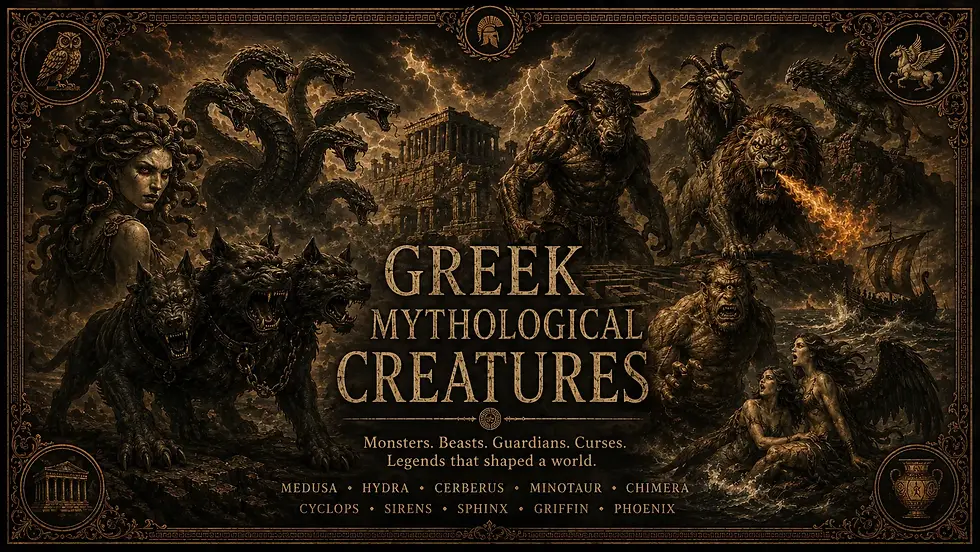
Greek Mythological Creatures
Monsters, beasts, curses, and other reasons ancient Greece needed heroes.
Greek mythology is filled with gods, heroes, prophecies, wars, punishments, and extremely unsafe travel conditions. But beneath the stories of Olympus and heroic glory is another world: a bestiary of monsters, hybrid beasts, underworld guardians, sea terrors, cursed beings, divine punishments, and creatures placed directly in the path of anyone unfortunate enough to be heroic.
Some Greek mythological creatures guarded sacred boundaries. Some haunted caves, marshes, islands, labyrinths, and coastlines. Some were born from monstrous bloodlines. Others were created through curses, divine wrath, or the kind of family history that should have been handled privately.
This guide documents the major creatures of Greek mythology, from Medusa and the Hydra to Cerberus, the Minotaur, Chimera, Sirens, Cyclops, Sphinx, Griffin, Phoenix, and beyond.Study carefully.
The ancient Greeks did not design their monsters to be survivable.
What Are Greek Mythological Creatures?
Greek mythological creatures are legendary beings from ancient Greek myth, epic poetry, folklore, and heroic tradition. They often appear as monsters, guardians, hybrids, spirits, giants, cursed beings, or divine animals.
Unlike ordinary animals, Greek creatures usually carry symbolic meaning. They are rarely dangerous for no reason. They test heroes, guard thresholds, punish arrogance, represent chaos, or mark the boundary between the human world and the divine.
A Greek monster is not just something with claws; It is a problem with a body.
The Hydra is not merely a serpent. It is escalation.
Cerberus is not merely a dog. He is the boundary between life and death.
Medusa is not merely a monster. She is fear, curse, beauty, violence, and divine punishment made visible.
The Minotaur is not merely a beast. He is the consequence of powerful people making poor choices.
That is what makes Greek mythological creatures so enduring. They are terrifying, yes. But they are also readable. Every monster tells you something about the world that created it.
Usually, the lesson is: do not anger the gods.
A close second is: do not enter the cave.
Famous Greek Mythological Creatures

Medusa
Medusa is the most famous of the Gorgons, remembered for her serpent hair and gaze capable of turning the living into stone.
In later tradition, Medusa became one of mythology’s most recognizable figures: part monster, part victim, part symbol of terror, protection, and transformation. Her severed head remained powerful even after death, making her one of the few creatures in mythology whose threat level did not meaningfully decrease after decapitation.
Known for: Petrifying gaze, serpent hair, Gorgon lineage
Hero encounter: Perseus
Threat type: Gaze-based death or transformation
Hydra
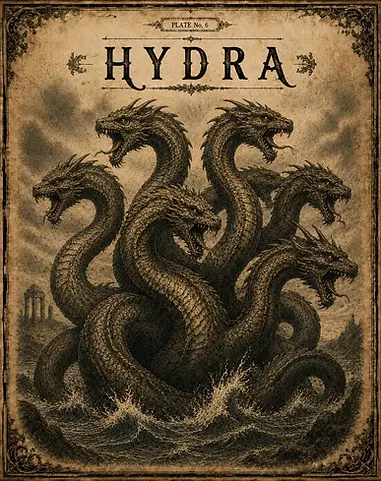
The Lernaean Hydra was a many-headed serpent that lived in the marshes near Lerna. Its defining feature was regeneration: when one head was cut off, more could grow in its place.
This made Hydra especially dangerous because brute force made the problem worse.
Heracles eventually defeated the Hydra as one of his Twelve Labors, but only by adapting his strategy. The Hydra is one of Greek mythology’s clearest reminders that some monsters cannot be defeated by simply hitting them harder.
Known for: Multiple heads, regeneration, venom
Hero encounter: Heracles
Threat type: Escalation

Cerberus
Cerberus was the monstrous hound of Hades, described as a three-headed dog guarding the gates of the Underworld.
His role was not to roam the earth causing random destruction. Cerberus had a job. He prevented the dead from leaving and the living from entering the realm of Hades without permission.
This makes Cerberus one of Greek mythology’s most important guardian creatures. He is a monster, but he is also part of the cosmic order.
Known for: Three heads, Underworld guardianship
Hero encounter: Heracles
Threat type: Boundary control
Minotaur
The Minotaur was a creature with the body of a man and the head of a bull, imprisoned in the Labyrinth beneath Crete.
Born from a curse and hidden away by King Minos, the Minotaur is a symbol of shame, violence, hunger, and royal failure. Each year, young Athenians were sent into the Labyrinth as tribute until Theseus entered the maze and killed the beast.
The Minotaur is one of Greek mythology’s most tragic monsters because he is both terrifying and trapped. He is the danger at the center of the maze, but also the consequence of powers far beyond his control.
Known for: Bull head, human body, Labyrinth of Crete
Hero encounter: Theseus
Threat type: Brute force and confinement


Chimera
The Chimera was a fire-breathing hybrid beast, usually described as part lion, part goat, and part serpent.
Some monsters frighten because they are large or deadly, Chimera frightens because it should not exist. It combines multiple animals into one unstable, unnatural body.
Bellerophon defeated the Chimera while riding Pegasus, attacking from above rather than approaching the fire-breathing hybrid directly. This was wise. Ground-level engagement with a lion-goat-serpent is not recommended.
Known for: Lion body, goat element, serpent tail, fire-breathing
Hero encounter: Bellerophon
Threat type: Fire and unnatural anatomy
Explore: Chimera
Cyclops
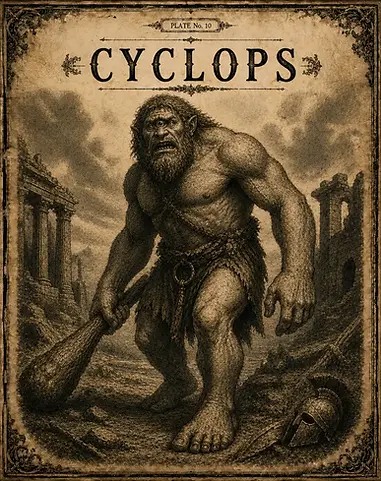
The Cyclopes were one-eyed giants in Greek mythology. Some traditions describe them as divine craftsmen, while others portray them as brutal and dangerous beings living apart from civilization.
The most famous Cyclops is Polyphemus, encountered by Odysseus in Homer’s Odyssey. Huge, powerful, and not especially open to hospitality norms, Polyphemus became one of the most memorable threats in Greek epic.
Cyclopes show the range of Greek monster tradition. Some are builders of divine weapons. Others are cave-dwelling cannibals. The single eye is consistent. The behavior varies.
Known for: One eye, giant size, immense strength
Hero encounter: Odysseus
Threat type: Giant strength and isolation
Sphinx
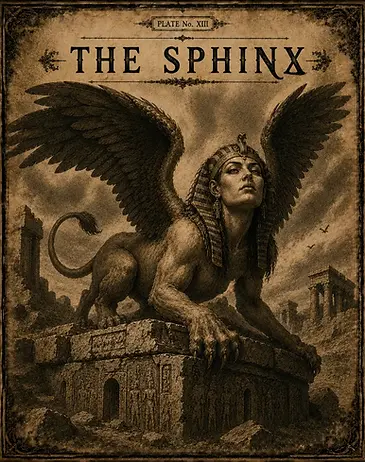
The Sphinx was a hybrid creature often depicted with a lion’s body, a human head, and wings. In Greek mythology, the Sphinx is most famous for terrorizing Thebes and posing a deadly riddle to travelers.
Those who failed to answer correctly were killed.
Oedipus defeated the Sphinx not through strength, but by solving the riddle. This makes the Sphinx one of Greek mythology’s great intelligence-based threats. You do not survive by running. You survive by answering correctly. No pressure.
Known for: Riddles, hybrid body, Theban legend
Hero encounter: Oedipus
Threat type: Deadly intelligence test
Griffin
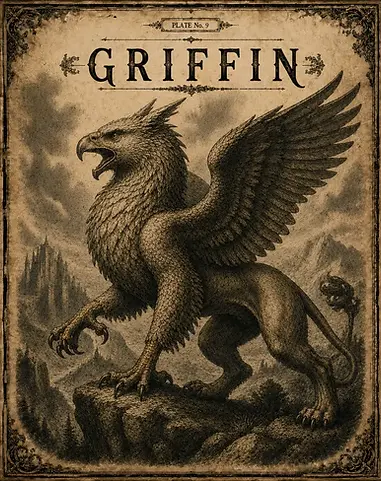
The Griffin is a legendary hybrid creature with the body of a lion and the head and wings of an eagle. Though not exclusively Greek in origin, Griffins appear in Greek art and literature as powerful guardians often associated with treasure, strength, and divine watchfulness.
The Griffin combines the king of beasts with the king of birds, which is exactly the kind of symbolic overachievement mythology enjoys.
Known for: Lion body, eagle head and wings, treasure guardianship
Hero encounter: Varies by tradition
Threat type: Aerial strength and guardianship
Phoenix
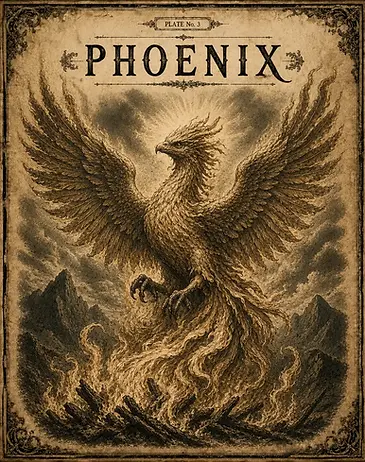
The Phoenix is a legendary bird associated with fire, death, rebirth, and renewal.
While versions of the Phoenix appear across several ancient traditions, Greek and later classical sources helped preserve the image of the bird that dies in flame and rises again from its own ashes.
Unlike many Greek mythological creatures, the Phoenix is not primarily a monster. It is a symbol: immortal, radiant, and nearly impossible to keep permanently dead.
Known for: Fire, rebirth, immortality
Hero encounter: None central
Threat type: Symbolic power rather than direct attack
Basilisk
The Basilisk is more strongly associated with medieval European bestiaries than classical Greek mythology, but it belongs naturally in the broader Greco-Roman monster tradition because of its serpent-like form, deadly gaze, and association with ancient natural history writing.
Often described as a small but lethal serpent or reptilian creature, the Basilisk could kill with its gaze, breath, or venom depending on the source.
It is essentially proof that a monster does not need to be large if it is sufficiently unfair.
Known for: Deadly gaze, venom, serpent form
Hero encounter: Varies by source
Threat type: Instant death or petrification

Explore Related Bestiary Profiles
Greek Monsters by Type
Greek mythology does not organize its creatures neatly. That would have been considerate.Still, many of the major creatures fall into recognizable categories.

Serpents and Dragon-Like Creatures
Greek myth contains many serpent-like and dragon-like beings, often associated with chaos, guardianship, poison, caves, water, or divine punishment. Examples include:
These creatures often guard sacred spaces, poison the land, or create problems that require heroic intervention. In mythology, the serpent is rarely just a snake. It is usually a threshold, a test, or an ancient force that resents being disturbed.
Hybrid Beasts
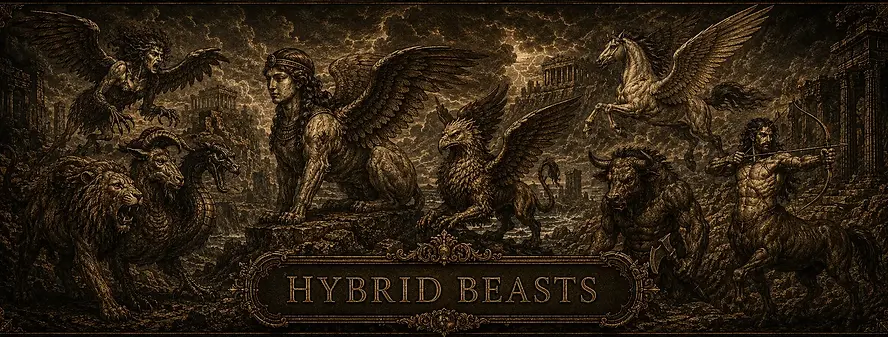
Hybrid beasts combine human, animal, and monstrous features into one body. Examples include: Chimera
-
Sphinx
-
Griffin
-
Minotaur
-
Centaur
-
Harpy
-
Pegasus
Hybrid creatures often represent disorder, transformation, or the crossing of boundaries. Some are noble. Some are cursed. Some are architectural arguments against combining too many animals into one creature.
Underworld Creatures
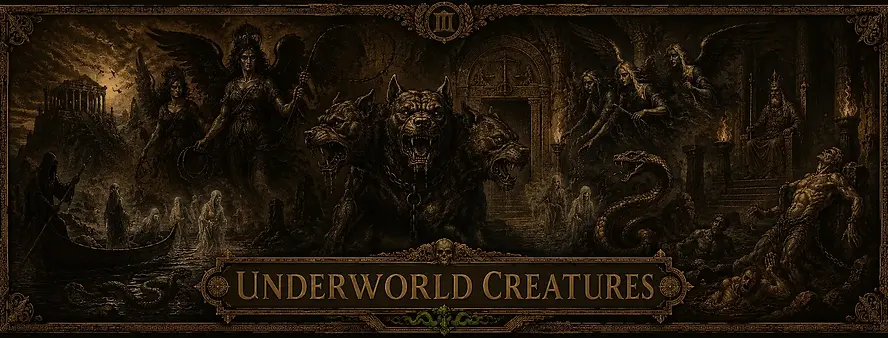
Some Greek creatures are connected to death, the afterlife, or the boundaries between worlds. Examples include:
-
Cerberus
-
Erinyes/Furies
-
Keres
-
Spirits and shades
These beings are not always evil. Many enforce the rules of death, punishment, oath-breaking, or divine justice. They are terrifying because they belong to a system humans cannot negotiate with.

Sea Creatures
Greek mythology is full of maritime danger, which makes sense for a culture surrounded by water and dependent on seafaring. Examples include:
-
Sirens
-
Scylla
-
Charybdis
-
Cetus
-
Sea serpents
-
Nereids
The Greek sea is rarely empty. It sings, swallows, coils, crashes, and occasionally sends a six-headed monster to handle the coastline.

Giants and Man-Eaters
Some Greek creatures are terrifying because of their size, strength, or appetite. Examples include:
-
Cyclops
-
Laestrygonians
-
Polyphemus
-
Antaeus
These figures often appear outside civilized space: caves, distant islands, wild lands, and places where hospitality has broken down. In Greek myth, being far from home usually means the local dining customs are about to become alarming.
Why Greek Mythological Creatures Still Matter
Greek mythological creatures endure because they are more than monsters. They are symbols with teeth.
Hydra is the problem that multiplies.
Medusa is the danger of the gaze.
Cerberus is the boundary between life and death.T
he Minotaur is the secret at the center of the maze.
The Sirens are temptation.
The Sphinx is intelligence under threat.
Chimera is nature assembled incorrectly.
These creatures remain powerful because they turn human fears into forms we can recognize. Death becomes a hound. Chaos becomes a serpent. Shame becomes a monster in the dark. Desire becomes a song. Confusion becomes a riddle.
Greek mythology did not simply invent creatures to frighten people. It gave fear anatomy.
Featured Greek Creature Guides
The Offspring of Typhon and Echidna

Most Dangerous Greek Mythological Creatures

Frequently Asked Questions
What are the most famous Greek mythological creatures?
The most famous Greek mythological creatures include Medusa, Hydra, Cerberus, Minotaur, Cyclops, Chimera, Sirens, Sphinx, Griffin, Phoenix, and Pegasus.
What is the most dangerous Greek mythological creature?
Hydra is one of the most dangerous Greek mythological creatures because cutting off one head could cause more heads to grow back. Medusa, Cerberus, Chimera, Scylla, and the Minotaur are also among the deadliest.
What Greek mythological creature can turn people to stone?
Medusa is the most famous Greek mythological creature known for turning people to stone with her gaze. The Basilisk is also associated with a deadly or petrifying gaze in later monster traditions.
What Greek mythological creature guarded the Underworld?
Cerberus guarded the gates of the Underworld. He prevented the dead from leaving and the living from entering the realm of Hades without permission.
What Greek creature lived in a maze?
The Minotaur lived in the Labyrinth beneath Crete. It was eventually killed by Theseus with the help of Ariadne.
What Greek mythological creature had many heads?
The Hydra was a many-headed serpent from Greek mythology. Some accounts also describe Cerberus with more than three heads, though he is most commonly known as the three-headed hound of Hades.
Are Greek mythological creatures real?
Greek mythological creatures are legendary beings from myth, folklore, poetry, and ancient storytelling. They are not considered real animals, but they remain important cultural symbols and literary figures.
Who is the mother of monsters in Greek mythology?
Echidna is often called the Mother of Monsters. She is traditionally linked with Typhon and associated with several famous Greek monsters, including Cerberus, Hydra, and Chimera.
What is the difference between Greek gods and Greek mythological creatures?
Greek gods are divine beings with worship, domains, and authority over parts of the world. Greek mythological creatures are legendary beings, monsters, hybrids, guardians, or spirits that appear within the myths, often as threats, tests, or symbols.
What Greek mythological creature is part lion?
Several Greek mythological creatures have lion features, including the Chimera, the Sphinx, the Nemean Lion, and the Griffin.