
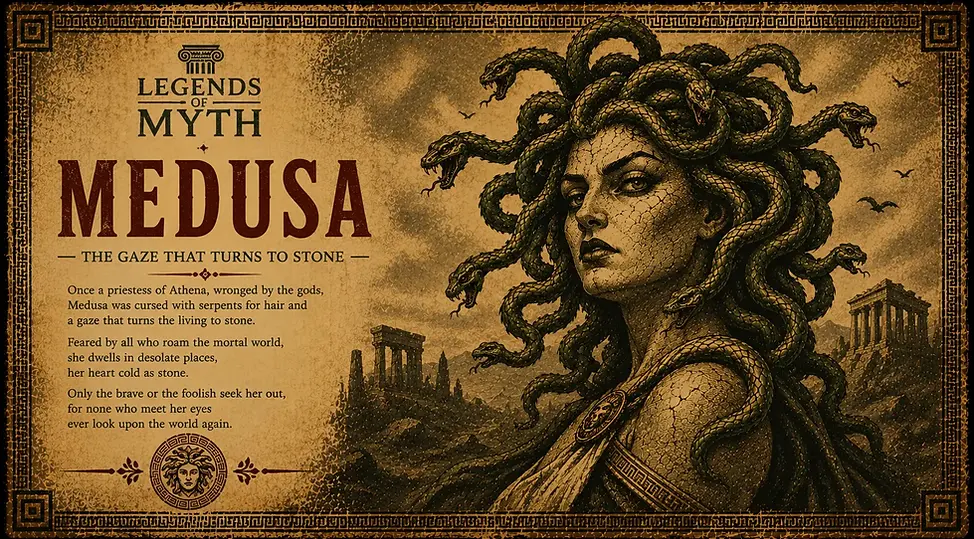
What is The Medusa?
(Myth, Powers, Weaknesses & Origins)
Medusa is one of the most feared figures in Greek mythology—a creature capable of turning living beings to stone with a single glance. Though often categorized as a monster, the historical and mythological reality surrounding Medusa is considerably more complicated.
Unlike dragons or hydras, Medusa does not rely on overwhelming size or brute strength. Her danger is immediate, intimate, and deeply psychological. Most encounters end before physical combat even begins. Which tends to simplify battle analysis while significantly reducing survivor interviews.
Across centuries, Medusa became a symbol of terror, punishment, protection, and tragedy all at once. She is not merely a predator within mythology. She is a warning embedded inside it.

Origin & Mythology
Medusa originates from Greek mythology and is one of the three Gorgons—monstrous sisters associated with death and fear. Unlike her immortal sisters, Medusa was mortal.
According to most versions of Medusa mythology, she was once a human woman renowned for extraordinary beauty. After an encounter involving Poseidon within the temple of Athena, Athena transformed Medusa into a monstrous form:
serpents replaced her hair
her appearance became horrifying to behold
and her gaze gained the power to petrify living creatures
Medusa was eventually slain by Perseus, who avoided direct eye contact by using a reflective shield. Which remains one of mythology’s strongest endorsements for indirect problem-solving.
Appearance & Anatomy
Medusa appears humanoid at first glance, which is part of what makes encounters especially dangerous.
Common physical descriptions include:
Living snakes in place of hair
Eyes capable of petrification
Pale or stone-like skin
Elongated fangs
Clawed hands
Serpentine lower body in some depictions
Observers frequently describe an overwhelming sense of dread before direct visual confirmation occurs. This is useful. Unfortunately, it is often useful approximately three seconds too late.
The snakes themselves appear semi-independent, constantly moving and reacting to nearby threats.

Field Profile
A quick-read threat assessment from the Legends of Myth creature archive.
Threat Class
Class IV: Catastrophic Entity
Best Known For
turning victims to stone with her gaze
Danger Level
9/10
Strength
5/10
Intelligence
7/10
Magic Power
9/10
Speed / Mobility
5/10
Stealth / Ambush
6/10
Weakness Exploitability
5/10
Survival Difficulty
9/10
Creature Stats
Abilities & Powers
Petrifying gaze — direct eye contact transforms victims into stone
Psychological intimidation — induces panic and paralysis
Venomous serpents — snake hair capable of biting and envenomation
Enhanced reflexes — highly dangerous in close combat
Supernatural resilience — difficult to injure conventionally
Territorial awareness — capable of detecting intruders rapidly
Want to compare two of mythology’s deadliest gazes? Read the full Basilisk vs Medusa matchup.
Weaknesses
Reflection vulnerability — indirect viewing bypasses petrification effect
Reliance on eye contact — abilities weakened if vision is obstructed
Limited ranged offense — strongest in visual proximity
Isolation tendencies — often inhabits remote areas alone
Mortal physiology — unlike many mythical creatures, Medusa can ultimately be killed physically
Habitat

Medusa is most commonly associated with:
isolated ruins
abandoned temples
coastal caves
desolate islands
remote mountainous regions
Her territory is often marked by:
stone statues in unnatural poses
complete absence of wildlife
silence
and the growing realization that the “statues” were not originally decorative
Unlike creatures that roam widely, Medusa appears to maintain fixed territory for extended periods.
Environmental confinement likely benefits her hunting strategy by restricting visibility and escape routes.
How to Defeat It
The first rule: do not make eye contact. This cannot be emphasized enough.
Historically successful strategies include:
Using reflective surfaces for navigation and combat
Fighting from range whenever possible
Limiting exposure in confined environments
Avoiding panic during visual disorientation
Attacking decisively once an opening appears
Perseus succeeded by viewing Medusa indirectly through a polished shield, proving that survival sometimes depends less on bravery and more on understanding basic optical principles.
Direct confrontation without preparation is strongly discouraged. Not because it is difficult, but because it ends immediately.
Could You Survive?
Your survival odds depend almost entirely on awareness.
If you know what you are dealing with beforehand: possible
If you turn a corner unexpectedly and lock eyes: effectively zero
Medusa is uniquely dangerous because her primary weapon bypasses traditional defenses entirely. Armor, strength, and combat skill become irrelevant if the encounter begins incorrectly. Which is admittedly an efficient design for a predator.
Estimated survival odds: extremely low without preparation


Frequently Asked Questions About Medusa
Who was Medusa before she became a monster?
In many versions of Greek mythology, Medusa was originally a beautiful mortal woman and priestess of Athena. After an encounter with Poseidon inside Athena's temple, she was cursed by the goddess and transformed into the snake-haired Gorgon known throughout myth.
Why did Medusa have snakes for hair?
The snakes were part of Athena's curse. Medusa's once-famous beauty was replaced with living serpents, transforming her appearance into something both terrifying and supernatural. The snakes became one of her most recognizable traits in mythology.
Could Medusa really turn people to stone?
According to Greek mythology, anyone who looked directly into Medusa's eyes would instantly be petrified. This power made her one of the most feared creatures in the ancient world and caused entire landscapes to become filled with stone victims.
Was Medusa evil?
Not necessarily. Modern interpretations often portray Medusa as a tragic figure rather than a villain. While ancient myths describe her as a deadly monster, many later retellings focus on the injustice of her curse and the suffering she endured.
Who killed Medusa?
The Greek hero Perseus killed Medusa during a quest assigned to him by King Polydectes. To avoid her petrifying gaze, Perseus used Athena's polished shield as a mirror and struck without looking directly at her.
How did Perseus avoid being turned to stone?
Perseus viewed Medusa's reflection in a mirrored shield rather than looking directly at her. With guidance from Athena and gifts from several gods, he was able to approach and defeat her safely.
What happened after Medusa died?
Even after her death, Medusa's severed head retained its petrifying power. Perseus used it against enemies before eventually giving it to Athena, who placed it upon her shield, known as the Aegis.
Was Medusa the only Gorgon?
No. Medusa had two sisters, Stheno and Euryale. Together they were known as the Gorgons. Unlike her sisters, Medusa was mortal, which is why Perseus was able to kill her.
Where did Medusa live?
Most myths place Medusa in a remote and isolated region far from civilization. Ancient writers described her dwelling among desolate coasts, rocky islands, caves, and lands avoided by travelers.
What does Medusa symbolize today?
Medusa has become a symbol with many meanings, including protection, feminine power, survival, transformation, and resistance against injustice. Modern literature, art, and popular culture often reinterpret her as more than a monster, focusing on the human story behind the legend.
Did Medusa have children?
According to Greek mythology, the winged horse Pegasus and the warrior Chrysaor emerged from Medusa after her death. Both were considered children of Poseidon.
Is Medusa based on a real creature?
No evidence suggests Medusa was based on a real creature. She belongs to Greek mythology, though scholars believe her story may have evolved from older protective symbols and monster traditions found throughout the ancient Mediterranean world.