
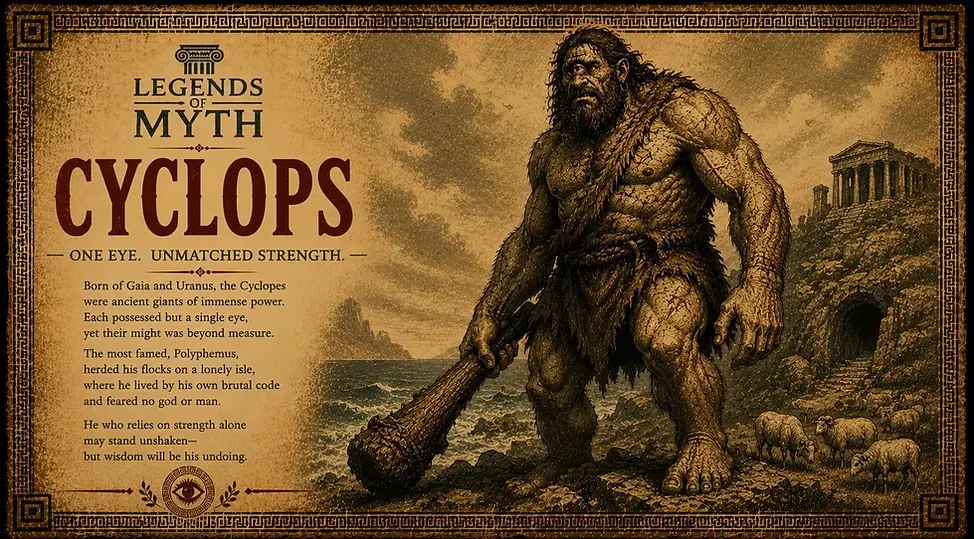
What is The Cyclops?
(Myth, Powers, Weaknesses & Origins)
The Cyclops is one of the most recognizable giants in mythology—a massive humanoid creature distinguished by a single eye positioned in the center of its forehead. While often portrayed as primitive or brutish, historical accounts of the Cyclops vary considerably, ranging from savage cave-dwelling predators to master craftsmen capable of forging weapons for the gods themselves.
This inconsistency has led historians and mythographers to an uncomfortable conclusion:
there may have been more than one type of Cyclops.
Some were builders. Some were shepherds. Some ate people.
As evolutionary branches go, it is a notably uneven distribution.
Regardless of origin, the Cyclops became synonymous with overwhelming strength, territorial aggression, and the deeply understandable fear associated with encountering anything large enough to use boulders as ranged weaponry.

Origin & Mythology
The Cyclops originates primarily from Greek mythology. In early Greek tradition, the original Cyclopes were primordial giants born from:
Uranus
Gaia
These elder Cyclopes were legendary blacksmiths who forged divine weapons, including:
Zeus’s thunderbolt
Poseidon’s trident
Hades’s helm
Later myths introduced a more monstrous variation, most famously the Cyclops Polyphemus in The Odyssey.
Polyphemus was depicted as:
enormous
violent
isolated
and alarmingly willing to eat stranded sailors
Which significantly complicated maritime tourism in the region.
Appearance & Anatomy
The Cyclops resembles a gigantic humanoid with a single central eye. Common physical characteristics include:
Towering height far exceeding normal humans
Massive muscular frame
Thick limbs adapted for lifting and throwing heavy objects
One oversized eye providing a broad forward field of vision
Coarse hair and heavily weathered skin
Primitive clothing or armor made from animal hides
Despite their size, Cyclopes are often described as surprisingly agile in short bursts, particularly when defending territory.
The central eye is both their defining feature and their most obvious vulnerability. Which, to be fair, probably occurred to them as well.

Field Profile
A quick-read threat assessment from the Legends of Myth creature archive.
Threat Class
Class III: Lethal Encounter
Best Known For
brutal strength, giant size, and a single watchful eye
Danger Level
8/10
Strength
9/10
Intelligence
5/10
Magic Power
3/10
Speed / Mobility
4/10
Stealth / Ambush
2/10
Weakness Exploitability
7/10
Survival Difficulty
8/10
Creature Stats
Abilities & Powers
Extreme physical strength — capable of crushing structures and opponents
Thrown projectile attacks — highly effective with rocks and debris
Durability — resistant to conventional physical damage
Territorial aggression — relentless when provoked
Enhanced depth perception compensation — adapts surprisingly well despite single-eye vision
Intimidation factor — sheer size alone disrupts enemy coordination
Weaknesses
Single-eye vulnerability — vision can be critically impaired if injured
Limited peripheral awareness — reduced side-angle perception
Predictable combat style — often relies on brute force over strategy
Large target profile — difficult to conceal or maneuver in confined areas
Isolation tendencies — often lacks coordinated support from others of its kind
Habitat

Cyclopes are most commonly associated with:
isolated islands
mountain caves
volcanic regions
remote wilderness areas
Their territories typically include:
livestock herds
crude stone shelters
evidence of massive tool use
and occasional indications that previous visitors were not permitted to leave
Most Cyclopes appear solitary, maintaining enormous personal territories with minimal tolerance for intrusion.
Environmental indicators of Cyclops activity may include:
massive footprints
broken trees
displaced boulders
and caves emitting sounds that strongly suggest you should continue walking in the opposite direction
How to Defeat It
Direct combat against a Cyclops is strongly discouraged. Not because victory is impossible, but because the creature is large enough to redefine what “close range” means.
Historically successful strategies emphasize:
Targeting the eye
Using terrain to limit mobility
Avoiding prolonged physical engagement
Attacking through deception rather than force
Maintaining distance whenever possible
In The Odyssey, Odysseus defeated Polyphemus not through strength, but through planning, deception, and improvised ocular surgery. Which remains one of mythology’s more memorable examples of adaptive problem-solving.
Could You Survive?
Possibly.
Cyclopes are dangerous, but not inherently unstoppable.
Your survival odds improve significantly if:
you avoid entering caves uninvited
you do not steal livestock
and you refrain from announcing your full legal name after escaping successfully
Historically, that final point has proven especially important. A Cyclops encounter becomes dramatically less survivable once the creature recognizes you specifically as the problem.
Estimated survival odds: low, but better than most giant predators


Cyclops FAQ
What is a Cyclops in Greek mythology?
A Cyclops is a giant one-eyed being from Greek mythology. Depending on the story, Cyclopes appear as divine blacksmiths who forged the weapons of the gods or as powerful, isolated giants who lived far from civilization. The most famous Cyclops is Polyphemus, the giant encountered by Odysseus in The Odyssey.
Why do Cyclopes only have one eye?
Ancient Greek sources describe Cyclopes as having a single round eye centered in their forehead. Mythology never gives one definitive explanation for why they have only one eye, but it became their defining feature and the source of both their terrifying appearance and their greatest weakness.
Was the Cyclops Polyphemus real?
No evidence suggests Polyphemus was a real historical figure. However, some researchers have proposed that discoveries of ancient elephant skulls—with a large central nasal cavity—may have inspired stories of one-eyed giants. Whether that theory is true or not, Polyphemus remains one of mythology's most enduring monsters.
Who was Polyphemus?
Polyphemus was the son of Poseidon and the most famous Cyclops in Greek mythology. In Homer's Odyssey, he traps Odysseus and his crew inside his cave and devours several of them before Odysseus blinds him and escapes.
How did Odysseus defeat the Cyclops?
Odysseus did not overpower Polyphemus. Instead, he used cunning. After getting the giant drunk, he drove a sharpened stake into the Cyclops's eye while he slept. The story became one of mythology's greatest examples of intelligence overcoming brute strength.
Were all Cyclopes evil?
Not necessarily. Greek mythology actually describes multiple types of Cyclopes. Some were savage giants like Polyphemus, but others were divine craftsmen who forged Zeus's thunderbolts and worked alongside the gods. Like many mythological creatures, Cyclopes were more complicated than simple villains.
How tall was a Cyclops?
Ancient myths never provide a precise measurement. Cyclopes are consistently described as towering giants capable of lifting enormous stones, forging divine weapons, and overpowering groups of humans with ease. In most artistic depictions, they stand several times taller than an ordinary person.
Where did Cyclopes live?
Greek writers often placed Cyclopes on remote islands, especially Sicily and the volcanic regions surrounding Mount Etna. They were said to dwell in caves, cliffs, and isolated wilderness far from human settlements.
What was the Cyclops's greatest weakness?
For all their size and strength, Cyclopes rely on a single eye. The legends repeatedly suggest that their vision can be exploited, and Polyphemus's defeat by Odysseus turned the eye into the creature's most famous vulnerability.
Are Cyclopes Titans?
Not exactly. Some Cyclopes were primordial beings born from Uranus and Gaia before the Olympian gods rose to power. Others, such as Polyphemus, belonged to a later race of giant shepherds. Greek mythology uses the term "Cyclops" for several related but distinct groups of one-eyed giants.
Did Cyclopes really forge Zeus's thunderbolts?
According to Hesiod's version of Greek mythology, yes. The original Cyclopes—Brontes, Steropes, and Arges—forged Zeus's thunderbolt, Poseidon's trident, and Hades' helm. In these stories, they were master craftsmen rather than monsters.
Why are Cyclopes still popular today?
Because they embody one of mythology's oldest fears: overwhelming strength combined with alien appearance. The Cyclops is both giant and human-like, familiar and monstrous at the same time. Thousands of years after Homer, that single unblinking eye still captures the imagination.
One eye. Endless legends.